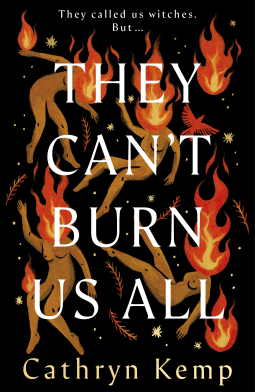
Published By: Bantam
Pages: 400
Released On: 13/08/2026
Westfjords, Iceland. 1655
Þuríður Jónsdóttir has grown up praying to the old gods and watching her father and brother practise rune magic.
But now, a witch-hunting craze is sweeping across the land of ice and fire, fuelled by the Protestant Reformation. Unlike elsewhere in Europe, those condemned as witches here are not women, but men of learning. And when Þuríður’s father and brother are accused of witchcraft and condemned to burn at the stake, she is helpless to save them.
As Lutheran Pastor Jón Magnússon’s accusing gaze turns to Þuríður herself, the first woman to be called ‘witch’, he will find that she is no ordinary woman.
She is prepared to fight back. But at what cost?
And in an age of fear and persecution, whose side will the community take? Who will fight for justice?
*****
Thanks to NetGalley and Bantam for the advanced copy of this title in return for an honest review.
***Contains Slight Spoilers***
I LOVED Cathryn’s book, A Poisoner’s Tale, and so I’ve been keeping an eye out for her follow-up.
I’ve read quite a number of witch-related historical books so there is a lot of competition. Although this looks at the witch trials from a male perspective, men accused of witchcraft, which gives it a whole new viewpoint which I found fascinating. I didn’t realise that men were ever accused of witchcraft but in Iceland apparently it was quite normal.
It’s based on the Kirkjuból witch trials, which I had never heard of and which sent me down a googling black hole.
Our main character of Þuríður (Thuridur) is mute which was an interesting choice. I can’t find any information about her in detail, so I can’t say if this was true or something Cathryn decided to do. And I’m a little on the fence. On one hand I do get the logic behind it, it puts this weird amount of power on this woman in a time where women were subservient. But on the other hand, I really struggled with it. I felt that without her voice, she wasn’t a deep enough character to invest in and so I was missing that connection.
Cathryn has such an ability to put you in a time and space. I know little about Iceland, and even less about 1600s Iceland, but everything was given so much care and attention and focus that you’re practically in this world yourself.
Iceland has been made into a character of itself. The harsh, raw environment is so atmospheric and makes everything feel so claustrophobic and eerie.
It is a bit topsy turvy when it comes to pacing. It starts off with a bang and the ending is good, and there are moments where it really kicks off, but then you get really slow passages. I don’t mind a mixture of slow and fast bits, that’s what makes a novel enjoyable. But I found some scenes particularly slow, and I found myself occasionally losing focus.
I didn’t enjoy it as much as The Poisoner’s Tale. That’s not to say I didn’t enjoy it, I did, it’s got everything I wanted – great research, inventive plot, full of atmosphere and a sense of space and time. She’s a fabulous author, I can’t argue with that. But I can’t quite put my finger on it, but it didn’t have that same spark.
Having said that, I finished it in a matter of hours, as compelled by the story as I was.
Overall, it is still a wonderful book. Cathryn is a fantastic storyteller. Her historical research is to worthy of admiration. The sense of space and time and environment and atmosphere is second to none, and she’s given us a completely different viewpoint of a rather overdone plot, but I felt the pacing needed tidying up and a bit more character to develop to make it as good as A Poisoner’s Tale, but I still highly recommend it for fans of historical fiction.

