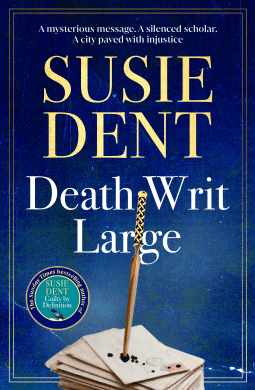
Published By: Zaffre
Pages: 400
Released On: 13/08/2026
A mysterious letter. A silenced scholar. A city paved with injustice.
When mysterious symbols appear as graffiti around Oxford, lexicographer Martha Thornhill recognises them from an alphabet created by a deceased writer whose papers she once worked on. But this is no publicity stunt, and tensions intensify when further graffiti is found near the body of a university lecturer.
Martha is not the only one to have doubts when the suspicious death is assumed by police to be a suicide. Called upon to lend their linguistic expertise to the case, Martha and her colleagues begin to unearth a tragedy that extends beyond the ancient walls of the university. As new messages portend more death, it’s clear that a spirit of vengeance is stalking the city’s streets, and may be reaching out towards them too.
*****
Thanks to NetGalley and Zaffre for the advanced copy of this title in return for an honest review.
I love Susie Dent and I really enjoyed her previous book, Guilty By Definition. I have also read one of her linguistic books, Words For Life, and own two of her others. Some sequels you can read as a standalone book and still understand it, but this is a book that you need to have read the first one first, otherwise a lot of it won’t make sense.
I was immediately sucked back into this world she has created, and it’s just as, if not more, fabulous as the first book. Literally everything about it is great.
It’s a slow book, but I mean that in the most positive of terms. It’s clever and sly, tiptoeing around, sucking you in, and you’re forced to take your time with it.
It’s a very intellectual book. That’s not to say I prefer “dumbed down” thrillers, I do like to be tested, but you do need to have your wits about you with this, which I enjoyed. It’s like the reader has to work it out along with the characters like a puzzle.
There’s more than a hint of Agatha Christie about it, of Miss Marple and Poirot and I love that. She’s found the feeling I get when I read classic murder mysteries and that’s hard to get right without just imitating what the old authors did.
Oxford in many ways can feel elite and the rest of us can feel like outcasts. But Susie has honoured that history, but she’s created an Oxford that welcomes everyone (even if one or more might end up dead).
I love that she starts every chapters with an unusual or antique word and description; it appeals to my nerdiness. She kept using the word “transliterated” which I’d never heard of before and is now one of my favourite words.
I’ve always been awful at working out whodunnits so I wasn’t expecting to figure this out, but I got it sort of half right, which I will take as a win. She has wrapped it up in so many layers of twists and turns and surprises.
It will appeal to fans of cosy crime, crime, thrillers, fans of words and great characters – just everyone.
It shouldn’t be a surprise but Susie is a master of storytelling, of using words to get a feeling across and make it natural. She is officially on my girl crush list, she’s just amazing and I want to be her when I grow up.

