Published By: Ebury Press
Pages: 256
Released On: 06/08/2026
The whole city was covered with dark clouds, and conflagrations were breaking out in various directions. Could all of this have happened at once? It was then that black drops of rain, as big as blackberries, began to fall – rain caused by the atomic bomb. I wondered what had happened to my home and church. With a pale face, I ran down the Koi highway…
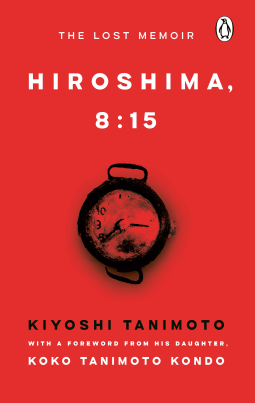
When the atomic bomb fell on Hiroshima at 8.15am on 6 August 1945, Methodist minister Kiyoshi Tanimoto was just beginning his day by helping a neighbour on the outskirts of the city. Unbeknownst to him at that moment, the events that awaited him over the following days and weeks were full of horror, but through his courageous determination to save his family, church and city from total devastation, Tanimoto would become internationally recognised as a hero of Hiroshima. In 1946, he featured in American journalist John Hersey’s seminal book Hiroshima which catapulted Tanimoto into global fame – but it is only now that we have discovered the manuscript that he wrote in his own words.
With a powerful introduction from Tanimoto’s daughter, Koko Kondo, a renowned peace activist in her own right, Hiroshima, 8:15 is a remarkable eyewitness account of this devastating moment of history. Written in the immediate aftermath of the bomb, the manuscript had been lost for many decades and was only recently discovered in a university archive.
Today, over eighty years later in a world fraught with conflict, Tanimoto’s story is a moving and powerful reminder of how the strength, love and resilience of the human spirit will always triumph over the things that divide us.
*****
Thanks to NetGalley and Ebury Press for the advanced copy of this title in return for an honest review.
“The future world is a world for everybody”.
Unsurprisingly, this is not an easy book to read but it absolutely captivated me.
There is a forward written by his daughter, which I assumed would be a couple of pages but is actually about 15% of the book. It gives us a completely different view of this all too famous tragedy, a child’s view, which I found very interesting.
Kiyoshi’s way of writing (I think he wrote this originally in English) is…stilted in parts, quite matter of fact, but still with emotion weaved in. And I don’t care that it doesn’t necessarily read in a perfect flow, because that’s not important in this case. It is eye opening to read and shocking. It reads as if written by someone who didn’t quite know the effects the disaster would have long-term – which is true. The idea that we have all this history but we still don’t seem to have learnt from it would appal him.
This is such an important book. The problem with disasters of this scale is we only see the numbers. But with this book, we are learning about the individuals behind those numbers.
We all know about Hiroshima and what happened there, but this is the first time I’ve read a survivor’s story, from moment to moment. It’s so tender but cruel and raw and honest and so sad but strangely uplifting and powerful.
What I did find interesting is that he talks about what happens after. We all know what happened on that day, but we don’t think about what happened to the people the day after, the week after, the month after. This wasn’t a one-day thing and it had a wide reaching disastrous effect on so many.
For a man for whom English is a second language, he’s done a great job of describing the heart and soul and pain of it all.
It is a bit stilted, the flow not perfect, but for a book like this it doesn’t matter, and in my heart I know I cannot give this any other star ranking than 5/5.
Whilst I was reading it, I kept googling things he was talking about, which was very grim and I don’t advise it, especially when it’s your night-time reading.
I know it’s not always possible but it would be great to read more of the kind of books, first-hand experience of human or natural disaster. I have found it such a brilliant book that I think it needs to be taught in schools.

