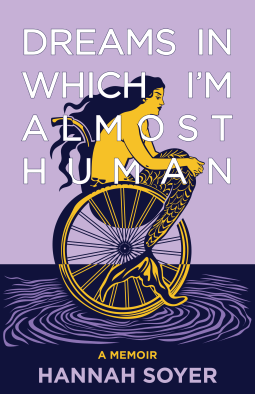
Published By: Red Hen Press
Pages: 232
Released On: 02/06/2026
At eight years old, Hannah Soyer had no choice but to undergo an intensive spinal fusion surgery, in order to keep her lungs from eventually collapsing. Fourteen years later, she chose another treatment for her neuromuscular condition: regular drug injections into her spinal fluid. But what does “choice” really mean, and how much weight do our choices hold?
In taut, lyrical chapters, Dreams in Which I’m Almost Human confronts and communes with bodily autonomy, medical and sexual consent, traveling abroad in a wheelchair, caregiving and caretaking, appreciating the natural world, family history, bedtime stories, fantastical creatures, Irish poetry, and the limits and wonders of language and love. A bold collection of genre-bending essays, this memoir is an investigation into what we (and our words) are capable of, as we yearn to make sense of our relationships to ourselves, each other, and the worlds we inhabit.
*****
Thanks to NetGalley and Red Hen Press for the advanced copy of this title in return for an honest review.
I don’t like to review memoirs like I review a novel, because it feels too personal for that. There are some comments of course, but I generally try to comment more on what the book means to me.
It is, at times, quite haphazard, flitting from time and point to another with no clear flow, which isn’t a dealbreaker but was hard to keep on top of at times.
It is a bit heavy on the metaphor use and imagery. It’s not a huge problem because I still enjoyed it but you do notice it quite a bit and I was wondering whether there could have been a simpler way of putting a point across.
The chapters are a wee bit long for my liking.
The memoir side of it is interrupted every now and again with stories about a mermaid, which confused me slightly. I understand it’s some sort of metaphor for her situation, of being “able bodied” and then in a “foreign” body, and whilst I liked these sections on their own, I’m not sure they added anything to the book overall. But I’d definitely read them if it was made into a short story.
This is going to be contradictory but go with it. I thought there would be more about her disability and less about her day-to-day. However, the rest of her life is just as important as the disability, and that is important. We need to remember that she isn’t her disability. So it’s a balancing act and I think she’s managed it well.
It’s not the stronger memoir I’ve ever read but that doesn’t really matter. It’s her life and it’s important we respect her experiences and feelings. She’s been honest and open, about the good and the bad times. I think this should be read by anyone, disabled or not. I’ve been an ambulatory wheelchair user for about 3 years now and I’m still trying to figure out how my body and this wheelchair fits into the world, and I think this book will really open your eyes to the things you may not have considered about disabled people.

