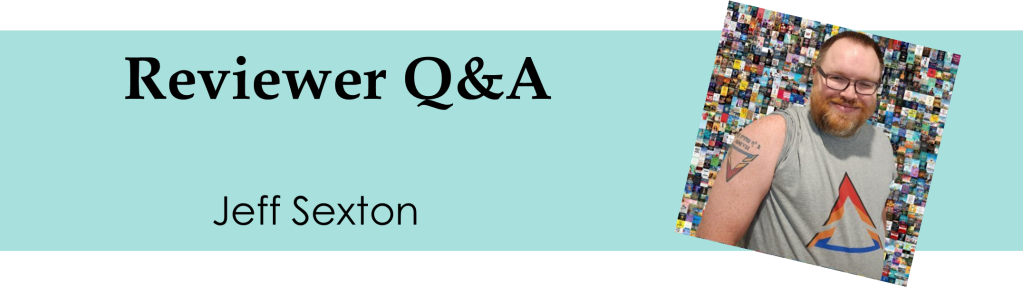
I’m the guy you come to when you want to hear about the books you’re not going to hear about from anyone else. I read some books that get tens of thousands of reviews, but I’m far more likely to be the very *first* review on a book… and not just because over 90% of my reading these days is Advance Review Copy books. I’ve read and reviewed over 1800 different books in just over a decade now, and my wide range of interests means that no matter what you’re into, I likely know a book that is decently close to it. In fact, an analysis of my reading once showed I was in the Top 1% for reading diversity in that system, and that diversity goes across nearly any classification you can imagine.
My overall review style is very no-nonsense, and I build a lot of my own experiences into them when and where relevant. Thus, I’m able to bring out a lot of themes and connections that few others would make, and I feel that makes my own reviews that much stronger for it. I make it a point to note that this was my experience with the book at hand, and particularly when I’m criticising a book, I try to both keep it to the book (rather than any attacks against the author) and specifically note that if you agree more with the author, you’ll have a better experience with the book than I did.
I started blogging at all in late 2008 shortly after the election of Barack Obama as the incoming POTUS, and I began BookAnon in July 2018 after deciding to fully leave all forms of political activism and focus on something I actually enjoy.
Blog: BookAnon.com
Social Media: @BookAnonJeff – X, BlueSky, Facebook, Instagram, YouTube
Meet Jeff Sexton
Questions on Reviewing
What made you start a book blog and/or book review social media account?
At the time, I had been operating a database tracking US mass shootings, school shootings, and those killed by police actions for several years but was growing jaded by just how large those problems were. I had already begun reading more and reviewing every book I wrote, and earlier that year Emily Bleeker had actually brought me into an Advance Review Copy review group several Lake Union authors were using that they were opening up new member slots for at the time. So I thought that opening up a new book blog would be a way to move away more completely from politics, and that has largely been the case over the last 8 years or so now.
What have you learned about the writing and/or publishing industry since reviewing?
So much. The most depressing, and one I constantly push back against and do everything I can to help correct, is the absolutely abysmal return rate of Advance Review Copy reviews – 10% is a fairly commonly accepted average, meaning 90% of ARCs sent out never result in a review being submitted anywhere. This, to me, is absolutely unacceptable. I, for one, will ALWAYS get that review in. I’ve missed a few deadlines here and there, but I generally go out on social media somewhere and explain what is going on (life, usually), and note that I will be getting them in as quickly as possible.
Are there any authors or books you have discovered through reviewing that you might have otherwise missed out on?
Oh so very many. Whether it be a Sean Griffin and his American Noir vampire trilogy that I was asked to help with by an author I’d worked with many times before or even the sometimes somewhat random-seeming books some of the Big 5 (what I call the ‘Megas’) publishers send me directly now due to my sheer volume of results on NetGalley along with the specific books I’ve reviewed there.
What do you think makes a great book review?
The singular thing I really look for in a review is that the person explains how they felt about the book. We don’t need a school style “book report” where you restate what happens in the book. In fact, please do NOT do that. Just explain how the book made you feel and what you thought about the book, even if as little as “I liked it because of the fast paced action” or whatever the case may be there. You don’t have to be as verbose as I am by any stretch. 26 words will be accepted by any review site I’m aware of, and I’ve used 35 in the last two sentences alone.
How do you handle reviewing a book you dislike?
This is where my “subtractive method” comes in, to a degree. For one, every book starts off at five stars with me, and I then have to have specific, describable, preferably objective-ish reasons to deduct stars, which I explain in the review itself. Thus, a one star review from me indicates serious issues, at least in my own opinion, while a five star means that it meets all technical expectations, including that it avoids preachiness or overt bigotry and gives us a complete tale within itself, among other issues. All of this noted, I have absolutely written five star reviews of books because of this where I simply did not actually like the book at all… and the review usually reflects that in what I write about the book. To the level that I’ve been known to outright say that while there was nothing that would allow me to deduct stars within my system, I flat out did not actually like the book at hand. (This doesn’t happen often, but it has happened.)
Is there anything that puts you off reviewing a book or author?
If I can tell up front that the book is going to be a polemic of some form – even sides I might generally agree with – I usually just skip it. In fiction, I’m looking for a good story first. If you can build your personal views into the story in service to the story, I actually consider that a positive, even when I disagree with them. But when the story is in service to the views, that tends to be something I don’t want to read.
Questions About Books
Firstly, the most important question, what books are currently ‘by your bedside’?
I’m a Kindle guy, so my entire library is with me at all times. I actually list the upcoming books I’ve got due in a page on my blog, so those are usually the ones actually pulled up. That noted, I’ve actually got The Cursed Thief by Matt James on my Kindle Colorsoft right now as the non-ARC book I’m (slowly) reading with my eyeballs. 😊
What children’s book would you recommend all adults read?
Grandpa’s Mountain by Carolyn Reeder. This is a Great Depression era story of the creation of the Shenandoah National Park and one young girl’s view of it as the government came in and took her grandfather’s land. Growing up knowing my own grandfather as “just” a fairly stereotypical Southern farmer (without the racism, Yankees 😉 ), this one hit hard when I read it as among the first chapter books I ever read nearly 40 years ago now while actively going out to his farm several times a year and even spending a week there every summer in this period of my life.
What was the last book you read that you would recommend?
Ticket to Ride by Kay Bratt is the most recent book I’ve finished as I write this, but on average I finish a new book every two to three days, so that changes frequently. But Bratt is a truly talented writer who wears her heart on her sleeve in so many ways, and it absolutely pours through in her writing. Ticket To Ride is book 15 in her Hart’s Ridge series that begins with the titular Hart’s Ridge, and I very much recommend you start there. There are things that happen in Ticket To Ride in particular that are based on bleeding edge FBI data that parents today very likely aren’t as aware of as they should be, and the way this book ends means the next book will actually feature something I’ve done myself before, and I’m really excited to see how Bratt works that.
Is there an author you always read?
I’ve been a proofreader for Jeremy Robinson for many years now, but yes, there are many authors I’ll read forever. David Wood, Rick Chesler, J.M. LeDuc, Michael McBride, B.R. Spangler, Laura Drake, Steena Holmes, Emily Bleeker, Erin La Rosa, Elizabeth Bromke, Hannah Mary McKinnon, A.J. Banner, I really could go on and on and on here.
Who is your literary icon?
Jeremy Robinson, absolutely. I met this guy back in MySpace before Kindle was a thing, back when he had literally like three books out and I bought two of them. I read The Didymus Contingency, featuring modern scientists developing time travel specifically so, unknown to his partner, one of them can go back to the time of Jesus Christ to specifically disprove what we know from the Gospels of his work. The way Robinson was able to craft a scifi action adventure tale that took Christianity seriously yet also wasn’t preachy about it at all and in fact used it in service to his story rather than the other way around was simply phenomenal, and honestly I’ve found few over the years who can do it anywhere near as well. Very nearly every other remotely similar author I’ve encountered over the years leans too hard one direction or the other, while Robinson got the balance exactly right. He’s also gone on to write nearly one hundred books now, including the “MCU approach to novel storytelling” (my own description of it) Infinite Timeline event that merged Christian elements with strong Greek Mythology and even outright horror elements to create a novel event unlike any I’ve ever seen. Oh yeah, and I first started writing reviews *at all* because Robinson asked me to write reviews of his books – so he is actually my genesis in reviewing and thus book blogging. Which I’ve told him to his face at one of the handful of times I’ve been able to meet him at his annual Robinsonfest event.
How do you sort your books?
IF they’re sorted at all (rarely) usually by title. I’ll redo the sort if I’m looking for a specific book from a specific author so that the sort order is author name at that point, but then I still take it back to the title default once I find the book I’m after.
What underrated book should more people read?
Again, I can literally name around a thousand books here I’ve personally read. So to keep this entry even somewhat short, let’s say Sean Griffin’s American Noir trilogy, Laura Drake’s For Roger, Cathy Lamb’s Ten Kids, Two Lovebirds, And A Singing Mermaid, Michael McBride’s Viral Apocalypse series, Brett Battles’ Project Eden series (which will make you rethink everything that happened in 2020-2021), and Nick Winters’ Hollywood Scent. But truly, follow me on your social media and/ or book site of choice, because you’re going to hear about so very many books that fit this particular category there.
What are three books or genres that define your taste as a reader?
My tastes themselves truly are so wide as to defy classification in any real way whatsoever, and I think my responses above show at least some of that. So how about I tell you the three books I’ve referenced in tattoos on my body? The first was a tattoo I call Freedom: Laws Redefined, which features an intertwined cross and the number 8 surrounded by the words “Freedom In Christ Alone”, and the 8 specifically is from the *movie version* of The Postman by David Brin. I actually read the book years after getting the tattoo… only to find that the Laws of 8 that play so heavily in the movie (including the climax, which inspired the tattoo) are barely mentioned in the book at all. Both book and movie are truly excellent though, just with completely different stories and messages. The second tattoo features R, the mathematical symbol for ‘Real Numbers’, along with a double equals sign, which is the C family programming equality test. It literally reads “Real equals Real”, which is a version of “Real is Real”, which is the subheading of Part III of Atlas Shrugged by Ayn Rand. The final tattoo, and this may be a bit of a shocker, is inspired by Jeremy Robinson and I got it months before meeting him in real life for the first time. It is actually a symbol Robinson drew out himself specifically for me, but it is from his book UNITY, where mono color versions of this tattoo – on the characters’ hands rather than their upper arm where mine is – indicate which role in a team that person plays. They’ll need to come together as a team in order to save the world, and there is (again, shocker) a strong Christian allegory here… if you know what you’re looking at.
The other answer here would be to point to more foundational books like Eli by Bill Myers, The Veritas Conflict by Shaunti Feldhahn, Warrior Class by Dale Brown, and Nobody by Creston Mapes – but that is four books, not three. 😉
And finally…
Do you have any other reviewers or bloggers you would recommend?
This is one area where I am unfortunately pretty horrible. I keep my head down and do my own thing so much that I really don’t have many blogging friends, though I have been working to change that more of late. But the one who has been with me for many years now is Lisa Henson of The Plain Spoken Pen. We work several of the same books in any given year, and she also reads a lot of books even I’ve never heard of as well.
Thank you Jeff😊


I think you may have copied a bit from another review. 🙂
I never said this:
“is often hard to know where to look for opportunities to review. Most of the books I have reviewed have been ones I have bought for myself and was motivated to share because of their quality. I have won a few competitions, and I always feel that it is only fair to share a glowing review of the book I won.”
My last statement was still referencing Lisa. 🙂
LikeLike
Ah Sorry that’s what I get for doing too many things at the same time
LikeLike
Easy fix. Awesome. Thanks 😀
LikeLike