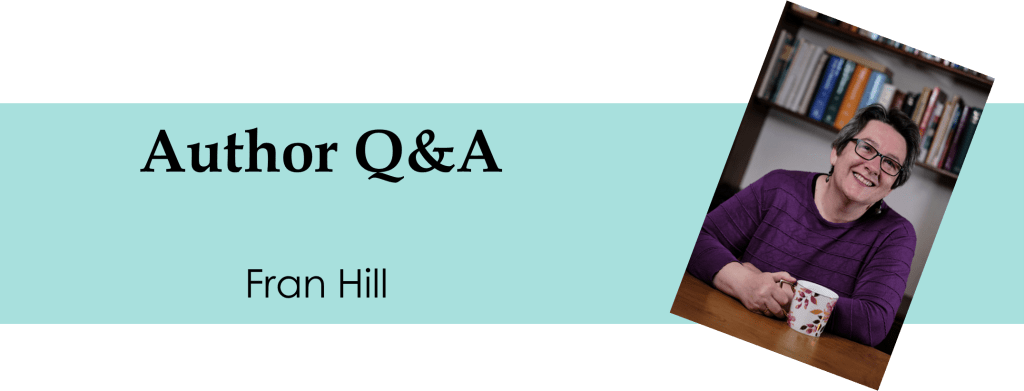
Fran is a newly-retired secondary school English teacher now freed from school bells and timetables to write full-time. ‘Full-time’ means ‘fitting it in around Homes Under the Hammer, listening to podcasts and helping with church activities or grandchildren’. She lives in Warwickshire, England, and often writes in local cafés, inspired by the buzz and chatter. She plays mediocre guitar in the church band.
As a child, she was in foster care, something that inspires much of her writing, which tends to focus on teenagers and how they are affected – for good or ill – by the adults in their lives.
Fran belongs to the Society of Authors, helping on the planning team for its Warwickshire group, and is a member of the Association of Christian Writers.
Meet Fran Hill
Questions on Writing
What is the hardest part of your writing experience?
I make things harder than they need to be with my lack of discipline and routine. Perhaps I haven’t adjusted yet to being self-employed. Unlike more sensible writer friends, I tend not to plan my days, preferring to ‘see how things go’. Inevitably, using this approach, they don’t go well at all. So I lean on my writing buddies to keep me accountable and I love deadlines to pieces because they make me get on with it.
What have you learned about yourself when writing?
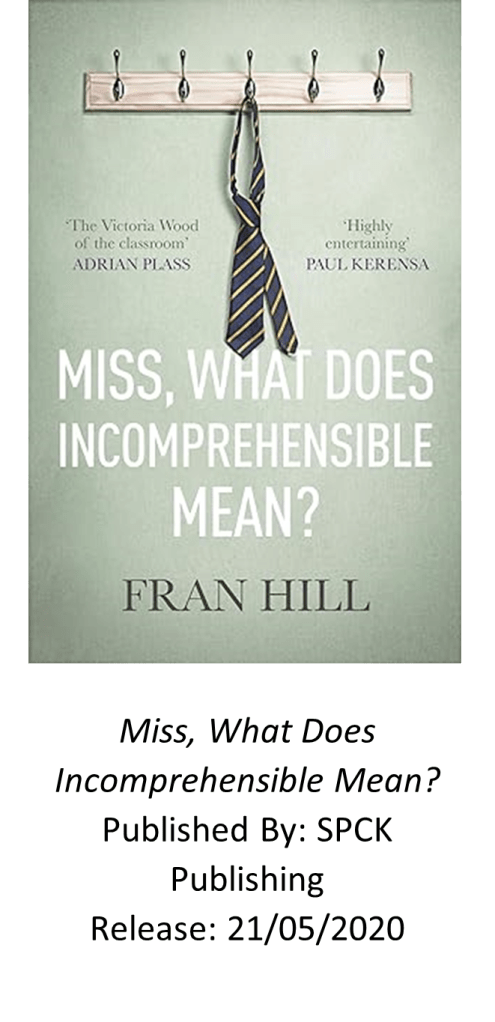
I’ve learned that you learn about yourself when writing! For example, when working on my memoir, Miss, What Does Incomprehensible Mean?, which began as light-hearted memories of a teaching year, I realised that I was holding back from exploring the deeper issues behind what kind of teacher I was, why I had imposter syndrome , and why I was so afraid to seem needy at work. Adding these extra layers to the book made it ten times better (IMHO). I think writing is therapy. Suddenly you see something you’ve written on the screen or page and realise you’ve expressed something revelatory from your subconscious.
Do you make yourself write everyday/regularly, or only when inspiration strikes?
See Q1 for an honest response to this. I was so much more disciplined when teaching full-time and I only had school holidays in which to write anything substantial. They say, don’t they, that if you want something done, you should ask a busy person? However, I can, once inspired, write for hours and hours, forgetting the time. I’m not exactly consistent. Having said all that, I probably do write something each day and shouldn’t be so hard on myself. Half a Substack post here, half a Q&A piece there, an idea for an article, a few lines of a funny poem in a tweet. It all adds up.
What does literary success look like to you?
It’s strange how I’ve changed my own goalposts over the years, the more I’ve had published. Right now, success looks like being listed for a prestigious award. I’d love that, even if I didn’t win. When I see that someone’s been longlisted or shortlisted for a prize, I think that’s already an affirmation, even if you don’t get to lift the trophy.
How much planning/world building do you do before writing, and how much comes along as you write?
I’m definitely a planner which might sound strange after confessing so much sloth above. But I like to know the key events of my story and how they impact on each other, driving on the narrative. This ‘causality’ is an essential feature of a decent novel. So, I draft a rough synopsis early on, even if details change as I begin to write. And they do. Characters can be so pig-headed, wanting to take control.
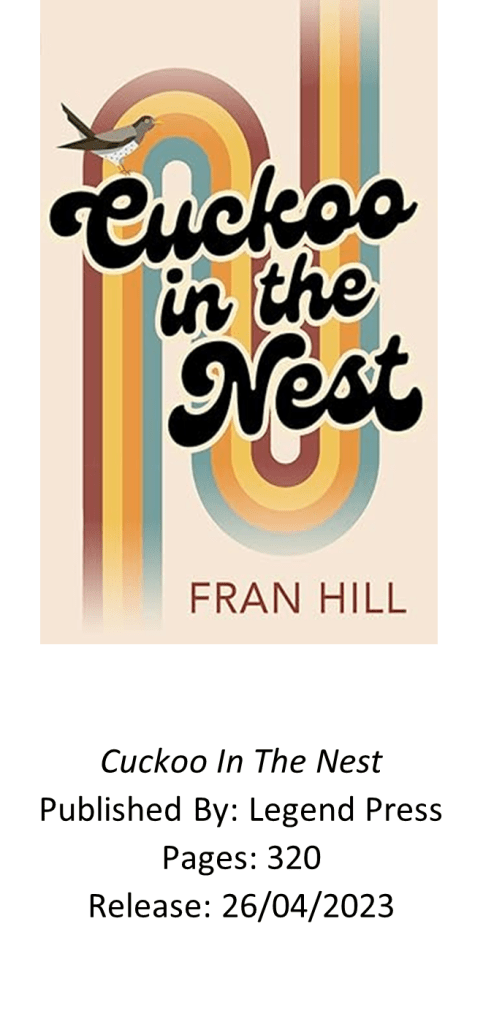
However, in terms of world-building, I often leave this until I have the story down, filling in specifics once the tale is told (for example, 1970s cultural, historical and social references in Cuckoo in the Nest). My manuscripts are peppered with reminders to ‘research 1970s cars’ or ‘find out when Arctic Roll was first a Thing’.
What differences did you find between writing a non-fiction book and then a novel?
Writing a memoir meant selecting events from my teaching year and arranging them in an order that would make the book a page-turner. There had to be a narrative thread, even though the book isn’t fictional. Also, events, characters, and settings were jumbled and stirred for confidentiality purposes. For Cuckoo in the Nest, a novel, I felt more free. I could pick whichever events I pleased and, if I wanted to have a lazy Dalmatian as a significant character or set the events in the year of the heatwave for the purposes of tension, I could. So I did.
How do you celebrate when a book is published?
Miss, What Does Incomprehensible Mean? was published in May 2020 during lockdown. A launch had been booked at a local pub, the guest list was long, and much Prosecco would have been drunk. Instead, I launched it alone from my front room over Facebook Live (ineptly). For Cuckoo in the Nest, therefore, I had two in-person bookshop-based launches in the same week, which might seem greedy but can surely be forgiven.
Questions on Books and About You
Firstly, the most important question, what books are currently ‘on your bedside table’?
I love short stories and am currently reading Stories For Winter, a British Library Women Writers collection. Authors include Angela Carter, Katherine Mansfield, and Edith Wharton. Next will be Lullaby by Leila Slimani, recommended on BBC2’s Between the Covers book club show (which has nearly replaced Homes Under the Hammer in my heart). Then it’s Chis Broad’s Abroad in Japan, and a couple of novels by Japanese writers. My daughter lives in Tokyo and it’s one way for me to share her life.
What children’s book would you suggest every adult read?
Children’s books, particularly picture books, are fantastic examples of story structure and worth studying. There’s a very special book called Look Out, Patrick! by author and illustrator Paul Geraghty, which my grandkids have loved. An adorable mouse protagonist meets, and JUST avoids, bigger and bigger disasters and threats, making his way obliviously through his day, until a final climactic scene when you are convinced he has met his end. I won’t spoil it, but let’s just say, there could be a sequel.
What does your writing space look like?
My part-time gardener husband is at home much of the time too, using different rooms to play the flute or listen to Yesterday In Parliament on the radio, so our use of spaces if very flexible. I can be writing in an upstairs back room overlooking trees in a graveyard, or in the back room downstairs next to the biscuits kitchen, or in the front room downstairs overlooking our Victorian street. Sometimes I’m at a desk but often I’m on a sofa with my feet up and my thighs getting hot from the laptop but that’s the only way I’ll have hot thighs.
How many books do you think you own?
You’re talking to an English teacher so I have a huge collection of plays, novels, short story collections, poetry anthologies, and non-fiction of all kinds. Most of it is dusty. Add to this all the novels I have bought for my own pleasure and we’re dealing with at least six tall bookcases plus two towers of books on my chest of drawers. We need a sort-out or a house with a library containing a high-backed reading chair and a gnarled oak table. I’m using the public library much more these days as a) libraries need supporting, b) authors still get paid for each loan, and c) if I buy many more books I will bankrupt myself.
Who is your literary icon?
It’s hard to choose but I’d have to say Jane Austen. She’s funny and acutely aware of human frailty, absurdity and hypocrisy. I love the way she rips apart social conventions and pretences, exposing them.
If you could own one rare/1st edition copy of a book, which would it be?
For the reasons above, I’d love a copy of Jane Austen’s Northanger Abbey, in which she has huge larks poking fun at the Gothic genre and at Catherine Morland, the protagonist who reads Gothic fiction and believes she is herself a Gothic heroine. On the other hand, it’s also a coming-of-age novel as Catherine becomes more aware of herself and of her own flaws and misapprehensions about the world. To do both in one book: Austen was a genius.
Is there an author who you always read?
If there’s a new Elizabeth Strout book, I’m on it. I love the way she portrays society and community and she does character brilliantly. Olive Kitteridge is so unlikeable and likeable at the same time. But also, on a technical note, I have learned so much from Stout’s writing style which is loose and relaxed and lyrical. Some people think my own writing style has been too terse and economical and I’ve tried to emulate her less precise sentences. It’s one of the best things about reading: learning from writers way ahead of you.
And finally, are there any plans for any new books? If so, what teasers can you give us?
I’ve written another book featuring Jackie Chadwick, the teen narrator in Cuckoo in the Nest, to be published by Legend Press, and I’m working on a third in the series, as yet uncontracted. In the first, Jackie is 14 and fostered. The second finds her at 17, trying to reconnect with her (unreliable) dad. In the third, she’s 19 and working out what kind of future she wants for herself. I’ll be sorry to let her go, or maybe I’ll keep going and Jackie Chadwick, Great-Great-Great-Grandma will end the series.
Thank you Fran😊I think we must share bedside tables. I’ve recently bought Stories For Winter from the British Library, bought Abroad in Japan for my Mum for Christmas, and absolutely adore translated Japanese fiction!
Fran Hill’s Books