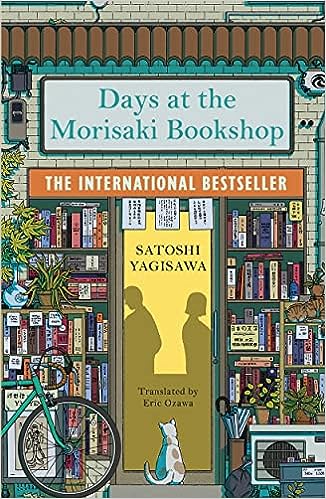
Published By: Manilla Press
Pages: 160
Released On: 04/07/2023
When twenty-five-year-old Takako’s boyfriend reveals he’s marrying someone else, she reluctantly accepts her eccentric uncle Satoru’s offer to live rent-free in the tiny room above his shop.
Hidden in Jimbocho, Tokyo, the Morisaki Bookshop is a booklover’s paradise. On a quiet corner in an old wooden building, the shop is filled with hundreds of second-hand books. It is Satoru’s pride and joy, and he has devoted his life to the bookshop since his wife left him five years earlier.
Hoping to nurse her broken heart in peace, Takako is surprised to encounter new worlds within the stacks of books lining the shop.
And as summer fades to autumn, Satoru and Takako discover they have more in common than they first thought. The Morisaki bookshop has something to teach them both about life, love, and the healing power of books.
*****
Thanks to Abi Walton at Bonnier Books/Manilla for the gifted proof of this book in return for an honest review.
I don’t read a lot of translated fiction, but what I do read is translated Japanese fiction. I haven’t met a Japanese book I haven’t instantly loved. I don’t know what it is about them. They have a way of reaching a little deeper in you. Not just to be an entertaining piece of fiction, but it talks to your heart and your soul and your very essence.
Books are important, they’re vital for mental and emotional wellness and your sense of enjoyment. But unless you are a book person, it’s hard to understand that, as reading is seen as just a frivolous pastime. But for us who have that close relationship with reading, there’s nothing better. And this book really shows how important books and stories can be and I love it. It’s probably the book I would recommend to people if they ask why I read so much.
There are two main characters – Takako and Satoru. Takako is a young woman whose life seems to implode on her and she finds herself adrift. And so she is taken in by her Uncle Satoru, offering her somewhere to live in return for some shifts in the bookshop. They both work really well off of each other. I liked Takako enormously, she felt the most relatable and I had a lot of empathy for her and her situation and I just wanted to see her succeed. Her Uncle…he took a bit longer to like, for me. There wasn’t anything particularly wrong about him, I just found him sometimes a bit of…somewhere between being too full-on and being a bit of a wet weekend. I contradict myself here, I realise that. I wanted him to be a bit more vocal, but then when he was, I found him too grating. But by the end of it, I really did like him and felt he gave his niece everything she needed during her lowest moments.
I have never been to Japan, and I don’t know how much of it in this book is 100% true to Japan, but after reading it it has made my want to visit even greater. It seems like the loveliest and friendliest country, and it sounds miles away (literally and figuratively) from anywhere I’ve ever been before.
The book is divided into two segments, and I must say, I did prefer the first. There was nothing wrong with the second, but it had such a different tone that it almost felt like a completely different story added to the end. If I’m being brutally honest, I think I would have preferred to have read 200 pages of the first story, rather than have it change, but that’s just me. I think also, it made it feel a bit flat. If they had stretched out the first segment a bit more, then it would have given us more time to really get stuck in, but by changing to another narrative, it was a bit stumbly. Although I don’t know if that’s down to the fact that I’m not reading it in its natural language.
It isn’t very plot heavy, it is more focussed on the characters and their past and future. The whole plot revolves around the bookshop really and how it has impacted upon their personal lives. Overall it touches on the themes of friendship and family, relationships, new beginnings, the power of books, forgiveness, and love.
What I did love is that, by setting the book in a bookshop, Satoshi has provided us with names of other Japanese books and authors, and I will definitely be making a note of them to seek out in the future.
Overall, I would say I really enjoyed this short story (I generally am not a fan of short stories), and it left me with a really happy, warming, cosy, positive, uplifting, and joyful feeling, and it really goes to show the transformative power that the right book can really have on a person and a situation, and I would gladly read it again.
 Books By Your Bedside
A very nice review, Victoria. It’s another book you’ve reviewed that has me interested in pursuing it further. Thank you for that! 🙂
LikeLike