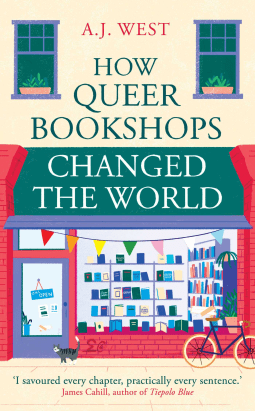
Published By: Oneworld
Pages: 336
Released On: 07/05/2026
For over a century, LGBTQ+ bookshops have been the unsung heroes of queer liberation
Home not only to books but chaotic community noticeboards, vicious rescue cats and countless meet cutes, queer bookshops have always been more than just bookshops, offering friendship, solidarity and sanctuary.
Travelling the world – Shakespeare and Company in Paris, Gay’s the Word in London, the Oscar Wilde Bookshop in New York – A.J. West explores the remarkable history of these bookstores. Tracing their evolution from under-the-counter operations to beloved out-and-proud institutions, West reveals how the queer bookshop stood at the vanguard of LGBTQ+ rights, offering support and vital information through the AIDS crisis and bringing the fight to Section 28 and book bans.
A powerful testament not only to bookshops but to the courage of queer booksellers, from Sylvia Beach hiding books from the Nazis in laundry baskets to Craig Rodwell facing off against the police at the Stonewall riots, A.J. West celebrates the shops and booksellers that brought queer literature and lives into the mainstream.
Bookshops covered include: The Highlander & Dove, The Librarie Parisienne, Shakespeare and Company, City Lights Bookstore, The London Underground, Adonis Bookstore, The Oscar Wilde Memorial Bookshop, Glad Day, Lambda Rising, Giovanni’s Room, A Different Light, Amazon Bookstore Cooperative, A Woman’s Place Bookstore, Womanbooks, Sisterwrite, Modern Books, Housmans Bookshop, Prinz Eisenherz, Gay’s The Word, Lavender Menace & West and Wilde, Vrolijk, Silver Moon, London, The Bookshop Darlinghurst, Paperxclips, Gay-on-Wye, Gayberystwyth Books.
*****
Thanks to NetGalley and Oneworld for the advanced copy of this title in return for an honest review.
I did have this on pre-order but sadly it was sacrificed in my “I have no money so have to cancel some pre-orders” cull. So I was thrilled when I was sent an e-arc of it. I love A.J and I love his books so much and I was intrigued to see how he fared with non-fiction.
As a white, heterosexual, cisgendered woman, I cannot pretend to understand what it meant to be a homosexual, particularly a homosexual man, back in the day, and even, to a certain degree, in today’s time, and why queer bookshops can be a place of sanctuary. And so these views come from my somewhat limited perspective.
There are footnotes in this book which I generally don’t like on a kindle version because the formatting goes a bit haywire. But I sought them out and I found them really interesting, and some quite moving and entertaining, and I highly recommend you read them in your finished copy.
I am a self-confessed nerd when it comes to books, writing, literature, bookshops, literary history etc. and so I was fascinated by what A.J has discovered in this book – and I’ve got a whole new list of bookshops to visit (like I needed an excuse).
I didn’t expect to feel so angry at a book about bookshops, but in terms of the historical context around how gay, lesbian, and trans people were treated, it’s just horrendous. I’m not going to put this era’s views on the beliefs of people in the 1700s for example because that doesn’t work. And whilst it’s still not acceptable, you can accept that those views were the views of that time. But to read similar views being thrown around in the last 100 years or so, or even in my lifetime, I just can’t comprehend it. Who cares if you’re a man who loves a man, or a woman who loves a woman? If you’re a man who doesn’t think a man should sleep with another men, then don’t sleep with another man. Done. Sorted. It’s as simple as that. I think what A.J has done here is about more than just bookshops, it’s such an important conversation to be had.
Historical non-fiction can be quite dry and overwhelming with facts. But A.J has found a good balance here. He’s given us all the information we want, but he’s kept the storytelling ability, wit, and his talent in talking directly to the reader that he has with his novels, which means it’s informative and a joy to read.
What I really liked is that, not only has he given us the history of queer books and bookshops, he’s given us the history of the world around them, and as someone who really regrets (but won’t admit to because then my Mum will say “I told you so”) giving up history before GCSE level, I found it fascinating.
Reading this reminded me of a moment a while back when I was ordering some books from ‘Gays the Word’ bookshop in London, when a stranger asked me why I was buying “gay books” from a “gay shop” if I wasn’t gay? And I thought to myself…I buy books about serial killers but I’m not a serial killer – yet. What an absurd thing to think, that you can only read books written by authors and featuring characters who believe in or feel the same way as you. I have read thousands of books in my life and yes, a proportion of them will be by gay authors or feature gay characters, but I don’t necessarily make it a conscious choice, I just read books. But I completely understand how important it is to have that choice, especially for younger readers who might be a bit confused by their sexuality or worried about being accepted. And to have dedicated spaces for those people to feel safe and catered for is something I have never given much thought to, I’ll be honest, because it’s never directly affected me. But A.J’s book explains just why they are such a vital lifeline for any reader, no matter your sexuality, to find somewhere you feel you belong.
And because I don’t already own 2,000+ books, I have now had to make a list of all the books he’s mentioned in this book.
I read the first half one evening and the second the next morning. It was so fantastic to read, and even though there are some difficult moments in it, he’s managed to infuse it with such a sense of warmth and hope.
 Books By Your Bedside