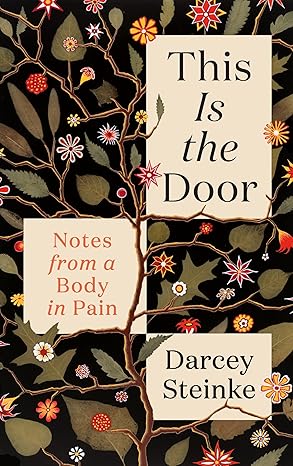
Published By: Canongate
Pages: 288
Released On: 26/02/2026
In This Is the Door, acclaimed author Darcey Steinke explores the agony and ecstasy of pain in its many forms. She takes readers through the archives and across oceans; she walks the tightrope between suffering and rapture, explores her own pain and that of a multitude of creatives characters from Frida Kahlo to Kurt Cobain.
Her journey reveals a series of questions. Does pain educate? Is pain always a physical experience of negation? How does pain push us to another level of creativity? What can we learn from wounding, from winnowing, from the stillness, the de-creation that intense pain brings? Whether it is the physical pain of an injury or illness, or the mental pain of heartache or loneliness, pain is an experience shared by all of us.
This Is the Door is a celebration of what the body can endure, and what it can achieve.
*****
I’ve not read any of Darcey’s books before and so had no expectations coming into it.
As someone who has a chronic illness or two, and in turn, chronic pain, I find it so difficult to put into words what that pain is like, even to people experiencing the same thing but Darcey has managed it very well.
I thought it was going to be more about her health and her experiences with pain, and there is that – and there’s more as it goes along – but it is predominantly about the history of pain, and what other people in history thought of pain. Which is fine, very interesting, and I thoroughly enjoyed it, but I’d have liked a bit more of that personal angle. Having said that, she has been very honest and open and shared some of her most difficult experiences with us.
What I did particularly enjoy was the positive spin she added. When you’re in that much pain, it can be hard to see anything other than misery and negativity, and I have never thought of it in relation to positivity, yet Darcey has managed that which was a revelation.
I read it in a day – the first day of a five-day hospital inpatient stint as it happened. Nonfiction books can often be dry and difficult to get through, but I devoured this as if it was a novel.
What I liked was that she hasn’t just focussed on physical pain, she has also talked about the pain of the soul or of heartache, which is obviously harder to prove medically. I have never had my heart broken romantically, but when my Dad died, the first thing I thought was how painful it was in my chest, like my heart really was breaking.
It isn’t an easy book to read, and it obviously has a lot of difficult subjects. There are a few illustrations and I’d have preferred some more to really add depth to her words. But overall I’d say there is this undercurrent of hope running through.
 Books By Your Bedside