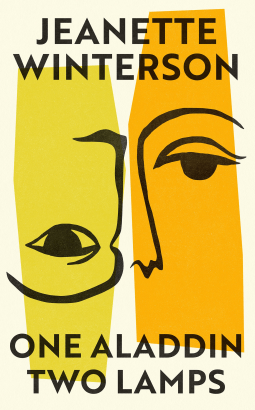
Published By: Jonathan Cape
Pages: 240
Released On: 13/11/2025
With her execution looming, a woman is fighting for her life. Every night she tells a story. Every morning, she lives one more day. One Aladdin Two Lamps cracks open the legendary story of Shahrazad in One Thousand and One Nights to reveal new questions and answers we are still thinking about today. Who should we trust? Is love the most important thing in the world? Does it matter whether you are honest? What makes us happy?
In her guise as Aladdin – the orphan who changes his world – Jeanette Winterson asks us to reread what we think we know and look again at how fiction works in our lives, giving us the courage to change our own narratives and alter endings we wish to subvert. As a young working-class woman, with no obvious future beyond factory work or marriage, Winterson realised through the power of books that she could read herself as fiction as well as a fact.
Weaving together fiction, magic and memoir, this remarkable book is a tribute to the age-old tradition of storytelling and a radical step into the future – an invitation to look more closely at our own stories, and to imagine the world anew.
*****
Thanks to NetGalley and Jonathan Cape for the advanced copy of this title in return for an honest review.
I wasn’t sure what I would make of this book as it sounded very different to what I would normally read but it also sounded intriguing. But I can’t say it lived up to it.
It is the first of Jeanette’s books I’ve read. Is this a fiction book? A memoir? An amalgamation of both? It leaves you with a strange feeling when you’re reading it because it’s neither one thing nor another.
It is written in a very sharp, staccato way. Sentences are often only one or two words long, which makes it quick to read, but it also makes it quite uncomfortable to read because you can’t get into a flow.
It feels very much like a stream of consciousness, like Jeanette just wrote down everything that came into her head, whether it linked together or not. But not a lot of it made sense. Individually, yes, but as a sentence, a paragraph, a whole story? I’m unsure.
I liked the passion she writes with when she talks about storytelling. We don’t necessarily think it’s important, it’s just stories. But storytelling is what we are as a species. We’re the one species (that we know of) that shares stories, orally and written down, with some stories being told down generations for hundreds of years, changing and adapting. But they’re very important and I like how much she’s focussed on that.
The premise really grabbed me. I really wanted to love it but it didn’t give me what was promised. There were some good bits, but overall it felt very flat and very confusing and I struggled to make heads nor tails of it. Maybe if I had read her books before and understood her writing style it might have been better, but I just couldn’t’ get on with it and I was glad it was a relatively short book.
 Books By Your Bedside