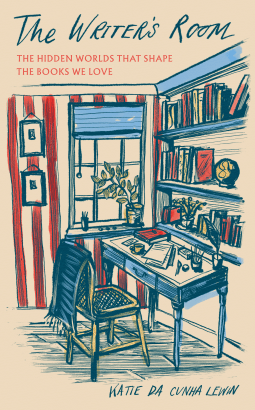
Published By: Elliott & Thompson
Pages: 288
Released On: 11/09/2025
What is it that so fascinates us about the spaces where writers work?
Why does a remote cabin, ramshackle shed or library garret, strewn with papers and piled with books, so capture our imagination?
The rooms of certain writers are mythologised almost as much as the works themselves: the Brontë’s study in the parsonage; Virginia Woolf’s garden room at Monks House; Sigmund Freud’s study, with its famous couch. They are preserved in writers’ houses or recreated in museums, pictured and described in newspaper columns and on Instagram, seemingly standing in for the labour of writing itself.
And yet writers, old and new, have worked in all kinds of places: in hotels, bedsits and boarding houses, at libraries, in bathrooms and while on the move. From Emily Dickinson’s hidden writing pocket to Lauren Elkin writing on her phone on the bus, from Maya Angelou in hotel rooms and Ernest Hemingway in Parisian cafés to the founders of Women of Color Press around their kitchen tables, writer and academic Katie da Cunha Lewin dismantles the familiar furniture of the writer’s room and opens it up.
*****
Thanks to NetGalley and Elliott & Thompson for the advanced copy of this title in return for an honest review.
I do love books about books and authors and writing.
This is a mixture of things. It looks at specific authors and their writing rooms and writing paraphernalia and whatnot, but it’s also a deeply personal exploration of Katie’s own experience, which was a nice balance.
I know a lot of people don’t understand the need to see something that once belonged to a celebrity. And I do understand what they mean in a way, I’m not one for fawning over celebrities. But if you pit me in Charles Dickens’ study and allow me to touch the paper, his desk, his pens, anything he has touched, then I’m afraid you’ll see a different side of me. And I can’t quite explain why but I think people who admire books and have favourite authors will understand.
In a way, it’s less about the writer’s space and more about them as a person, how they write, where, when, why, with a backdrop of location. It’s not a how-do, it doesn’t give advice on how to set up your own space.
I’d have liked some more photos, but I’m aware I had a digital ARC and so that may change before publication.
It got me thinking about the spaces I write in. I do have an office of sorts, which is basically a desk I bought in lockdown shoved to the wall in the spare bedroom. That’s where I should write. But I also write on the sofa, at the dining table, in bed, in the notebook I’ve shoved in my handbag when I’m out. And sometimes I write in my head. Part of me wishes I had more discipline, because when I used to work a “proper” job, I went to my desk, logged on at 8am and worked there until whatever time the day finished. But now, I probably only work in the office once week, but I do admit I certainly get more done at the desk, but it feels more official and, at times, more pressurised to create something.
I do want to go on a tour of writer’s workspaces now.
It’s a very information heavy book, which I liked. It showed the amount of research Katie must have had to do in order to give this book such gravitas.
 Books By Your Bedside