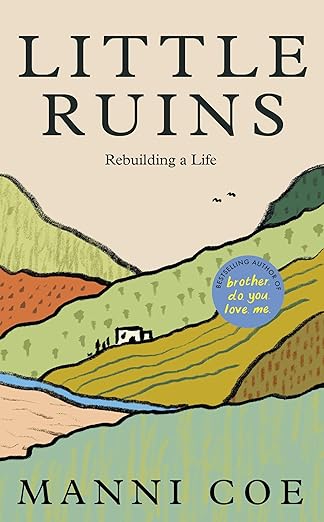
Published By: Canongate
Pages: 352
Released On: 28/08/2025
Looking to begin a new chapter after years on the move, Manni Coe and his partner take a risk and buy ‘The Corner’, a crumbling but beautiful 150-year-old farmstead tucked into a remote valley in Andalusia, surrounded by olive trees. It’s perfect for their unconventional family of three: Jack, Manni and his youngest brother, Reuben. Secluded from the village by a river and in awe of the extraordinary Spanish landscape, Manni watches their land teem with mountain goats and wild boar, red deer and seasonal swallows. He begins to feel that this might be the place where each of them will find their peace.
But nothing is ever so simple. Though their hilltop village offers food, fellowship and guidance, many visitors bring their own problems and troubled pasts over the river. While Manni and Jack work to afford rebuilding The Corner, who will care for Reuben in the way that he deserves? And as Manni starts to realise that the scars from his childhood – kept hidden for all these years – might not have healed at all, a single, terrible event threatens everything the three of them have spent so long building together.
*****
Thanks to Canongate for the advanced proof of this title in return for an honest review.
It’s rare that I ever call a book “perfect” but there are no other ways to describe this book, but let me try.
I have a copy of Manni’s previous book that he wrote with his brother Reuben, but I haven’t read it yet, but having finished this you can bet it will be flying up my list
It took me a while to actually settle down and read this. I carried it around with me for a few days, from room to room, wating to read it, but I knew it was going to be a big book in terms of theme, and I felt it deserved all my focus and emotional concentration.
The way Manni writes is – and I mean this in the corniest way – life changing. It is some of the most beautiful prose I’ve ever read, so full of love and heart. Which you don’t always expect from a non-fiction book, which have a tendency to be a bit dry at times.
Trauma, be it mental, physical or emotional, is so deeply personal that it is often impossible to talk about it, to find the words that’ll do it justice. I know I struggle to truly explain the trauma I’m going through. But Manni has done it so perfectly, like he has read every reader’s soul and knows exactly how to frame it, he knows exactly what each reader needs from this book.
This book is one of the reasons why I’m glad of insomnia, because it gives me the chance to read this in one sitting.
It’s an odd one, because whilst there is the personal story element, the main crux of the book is about three men moving to Spain and learning to live in a solitary area whilst they renovate the house. Which sounds like it’s going to be quite dry, but oh it is anything but. It’s exciting and fascinating and gorgeous and I just didn’t want to ever stop reading it.
There are shorter chapters and longer ones (I prefer the former), which means it flows really well. The same goes for the sentence length, it makes it easy to read.
What I really loved was how Manni writes about his brother Reuben. A lot of people are not comfortable with disability or those of us who are in any way different, and that’s not necessarily their fault, but it is what it is. My mother taught at a school for children with disabilities from when I was about 7 and so I know no different. But it’s amazing the difference you see if you’re with someone who hasn’t got much experience with disabled people. And that’s what I love about how he writes about his brother (I know I haven’t read his previous book and so he might have been more in-depth there). He writes about Reuben in this as his brother, like any brother would do. He writes about him in the same way he writes about his partner and that was joyful. He’s just another addition to the story, and it doesn’t need to be spelled out in black and white about how he might be different to other people. You can see the love they have for each other and it’s so special.
Manni explains how he uses writing to deal with trauma and that’s what this book is aimed to do as well, ad I really do hope it’s brought him some peace because it is really very good.
It is perfectly addictive. It’s sad but joyous and hopeful and, amongst all the trauma, there is such an uplifting soul about it. I would put this into every single person’s hand if I could.
It might have took me a while to start reading it, but I never wanted it to end.
 Books By Your Bedside