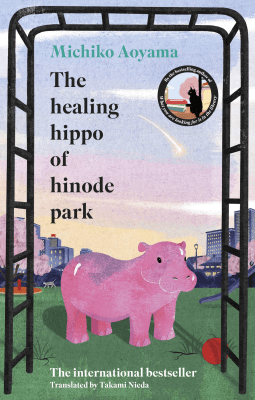
Published By: Doubleday
Pages: 256
Released On: 14/08/2025
Translated By: Takami Nieda
‘Kabahiko is an amazing hippo. People say that if you touch the area of his body that you want to make better on yours, he’ll provide a cure’
Nestling at the bottom of a five-storey apartment block is the children’s playground, Hinode Park. If you look to the side, standing on stubby legs, is a hippo. Its upturned eyes give it a teary look, yet for decades, its quiet power has sustained the hearts of one community. Meet the neighbours who will reach out to kabahiko:
–Kanato presses his head to the hippo’s cheek, hoping to recover the stellar marks he once scored;
– Sawa, a konely new mother, strokes its mouth, hopes to connect as she once did when she was an award-winning retail assistant;
– Chiharu, a wedding-planner, hopes to be able to listen for the happiness of others;
– Yuya avoids sports day with a fake injury, only to find he really is in pain.
– despite Kazuhiko’s fading eyes from too much editorial work, he will learn to see life’s everyday wonders.
*****
Thanks to NetGalley and Doubleday for the advanced copy of this title in return for an honest review.
I loooooooove Japanese fiction. They’re always so whimsical and fun and magical and always leave me feeling uplifted. Throw in my Mum’s favourite animal of a hippo and I’m in.
I loved Michiko’s previous book, What You Are Looking For Is In The Library, which bodes well for this one.
Like the majority of Japanese fiction I’ve read, it is very repetitive. It focusses on a handful of characters and each of their interactions with the hippo. I generally don’t like much repetition in a book but it works here, it helps the reader to feel happy and uplifted and cosy.
Where this differs from other translated fiction I’ve read is that it’s less about magic. The hippo isn’t magical, it’s not a fantasy hippo. It’s just the catalyst to get the characters to look inside themselves and achieve their dreams themselves.
This one felt quite juvenile. I don’t necessarily mean that in a negative way. But a majority of the characters are children, and some of the problems are quite small problems – not that there’s anything wrong with small problems, people react differently to problems. But it means it wasn’t hugely layered to had much depth to it.
I did enjoy it, it’s not quite hit the heights of other Japanese books or Michiko’s other books, but it is a lovely book. It’s quick and easy to read, fast paced but not rushed. It’s warming and cosy and a beautiful read. It’s just not anything special.
 Books By Your Bedside