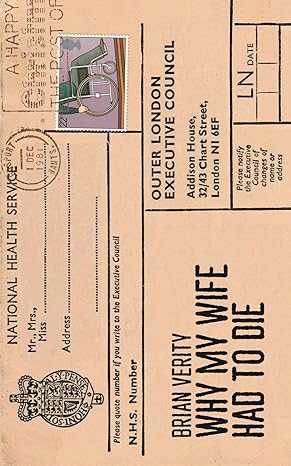
Published By: Envelope Books
Pages: 220
Released On: 17/09/2024
Huntington’s disease leads to physical and mental deterioration. There is no cure. It is handed down genetically, with a 1 in 2 chance of inheritance that cannot be determined until the disease shows itself, often not until the sufferer is in their 40s.
Many do not know they carry the gene or are at risk of passing it on. Those who do know, because a parent has suffered from it, may wait a lifetime before finding out whether they are safe or not.
The prospects are horrific. After his first marriage failed, Brian Verity had a breakdown and married the woman who had nursed him back to health. Within a few years, she started showing the signs of Huntington’s that he had noticed in other members of her family and that he already had a morbid fear of.
Having fallen in love with her in hospital, he now found himself repelled by what was happening to her, fearful of his own psychological fragility and inability to cope, and yet committed to protecting her from the distress that lay in wait.
What should he have done? What should society do?
*****
Thanks to Envelope Books for the gifted copy of this book in return for an honest review.
Well, isn’t this a heartbreaker! This one was always going to be hard to read, with such a topic to pull on the heartstrings, but Brian has done it with such sensitivity and tenderness.
I really felt for Brian. He comes across, at times, very unlikeable but I can’t hold it against him. No-one knows what it is like to care for a loved one, and sadly it can bring out the uglier sides to you. but I cannot say anything negative about it because it can’t be helped. You’re tired, you’re stressed, you’re angry, you’re worried – and soon those emotions can build up and the only person available to lash out on is the person you are caring for, and it’s not their fault.
Brian is not backwards in coming forwards with this book, and he puts across some very controversial opinions, some that wouldn’t see the light of day now if he was in the same situation, but were ideas that presented themselves at the time. They’re not always easy to swallow or talk about but I’m glad Brian has added them; Huntington’s Disease is horrible, and a lot of people struggle to talk about illness or disability or death, but Brian has put it all on the page, good or bad, and we’re forced to ask these questions of ourselves.
It’s a relatively short book but it did take me a while to read because it was so intense, it wasn’t a book I could sit down and lose myself in from beginning to end because it was very emotional.
Whoever designed the cover of this book has done a very good job. It’s deceptively simple – a light pink cover that almost looks like a postcard, but it’s only when you get closer do you realise it’s an NHS card, showing that Mary Verity has Huntington’s Disease and the prognosis is “irreversible disability”, and so you instantly know it’s going to be an important book.
This is set in the 1970s or so, when there was no cure and little treatment for Huntington’s Disease, and even though there is still no cure, I am glad that things have developed in terms of treatment and living with the condition.
I do not know much about the disease and I found this to be really informative, but it is the right side of educational – it doesn’t feel too information heavy. This is more about how the condition has affected Brian and his wife, rather than what the condition actually is.
Brian has opened up his home, his family, and his heart with this book and I commend him for it, it can’t have been easy to return to those times. I would like to know what happened to Brian after his wife’s passing, whether he moved himself away from the medical/caring sphere or whether he continued to push against the stigma against such a condition.
 Books By Your Bedside