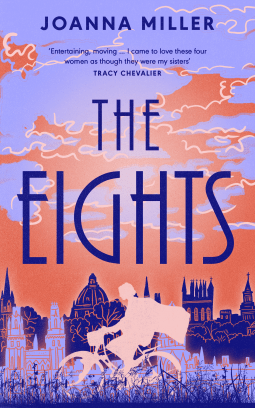
Published By: Fig Tree
Pages: 352
Released On: 17/04/2025
Oxford, 1920. For the first time in its 1000-year history, the world’s most famous university has admitted female students. Giddy with dreams of equality, education and emancipation, four young women move into neighbouring rooms on Corridor Eight. They have come here from all walks of life, and they are thrown into an unlikely, life-affirming friendship.
Dora was never meant to go to university, but, after losing both her brother and her fiancé on the battlefield, has arrived in their place. Beatrice, politically-minded daughter of a famous suffragette, sees Oxford as a chance to make her own way – and her own friends – for the first time. Socialite Otto fills her room with extravagant luxuries but fears they won’t be enough to distract her from her memories of the war years. And quiet, clever, Marianne, the daughter of a village vicar, arrives bearing a secret she must hide from everyone – even The Eights – if she is to succeed.
But Oxford’s dreaming spires cast a dark shadow: in 1920, misogyny is still rife, influenza is still a threat, and the ghosts of the Great War are still very real indeed. And as the group navigate this tumultuous moment in time, their friendship will become more important than ever.
*****
Thanks to NetGalley and Fig Tree for the advanced copy of this title in return for an honest review.
I haven’t been able to move on Twitter (I still refuse to call it X) for talk of this book so I was thrilled to get an early copy!
This book follows four students: Beatrice Sparks, Marianne Grey, Theodora Greenwood, and Ottoline Wallace-Kerr.
As bizarre as it sounds, I kept getting Little Women vibes. Let me say now, it has no link to Little Women, it’s not the same story, it’s not the same time period, or even the same location. But having these four women grow close, learn how to live in this new world…every so often my brain sparked this connection which was surprising.
Obviously, I was not around in Oxford in 1920 – although sometimes my joints tell me I was – but I know some of Oxford, and Joanna has created such a clear sense of time and place that you can practically insert yourself into the story.
Women going to University and getting an education is something we take for granted now – Lord knows I didn’t appreciate my time at Uni – and so it does us good to be reminded of our struggles in a time that, relatively speaking, wasn’t that long ago.
I love the focus on women, how strong they are, smart and powerful. This isn’t feminism just to tick a box, these women are front and centre. I read another review of this and something stood out to me. Someone said that whilst Joanna has written these characters to be strong, determined to overcome the prejudices and restrictions, she hasn’t made them too modern, and I completely agree. These are clearly women in the early 1900s, and unfortunately there are restrictions in place, and she hasn’t sugar-coated that.
There’s the occasional flashback of war, snippets of scenes, letters, thoughts. It’s not overly so, because it’s not a war book, but you can’t exist in 1920 without having some sort of link to it, and I think it helps bring some wider historical context to the story.
It was surprisingly humerous at times. It’s an historical novel, a character study, there’s war, it’s serious, but there is humour, especially thanks to Otto, and I felt that was a nice relief from the importance of women breaking that glass ceiling of the time. I also wasn’t expecting so many surprises. You expect twists or surprises in crime books, thrillers, sci-fi, fantasy etc. but historical books…not so much. And I’m not saying Joanna has made it a twist per second, but there were little surprises which I liked.
I don’t know very much about this time period and the whole women vs. education argument, and so I cannot say how accurate this is, but it sounded so correct, so full of depth. It’s clear that not only has Joanna done an enormous amount of research, you can tell she’s got a passion for the topic and the time period and that clearly comes through.
I do have one thing to say though. I won’t call it a negative because that suggests there’s something not right with the book, and that would be untrue because it’s fabulous. But personally I’d have liked to have read just a bit more about the women’s’ courses themselves, what they’re studying, their classes etc. alongside their general lives in Oxford. But that’s just because I’m a big nerd.
Going on the little author bio in the book, Joanne lives in my home county and whilst we’re in different towns, I’m declaring her practically my next door neighbour and best friend.
 Books By Your Bedside