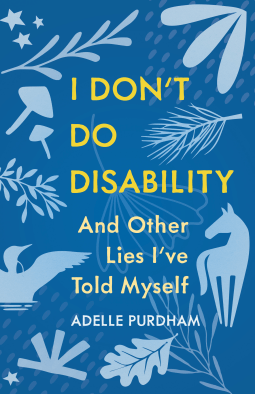
Published By: Dundurn Press
Pages: 232
Released On: 03/12/2024
With the arrival of her daughter with Down syndrome, Adelle Purdham began unpacking a lifetime of her own ableism.
In a society where people with disabilities remain largely invisible, what does it mean to parent such a child? And simultaneously, what does it mean as a mother, a writer, and a woman to truly be seen?
The candid essays in I Don’t Do Disability and Other Lies I’ve Told Myself glimmer with humanity and passion, and explore ideas of motherhood, disability, and worth. Purdham delves into grief, rage, injustice, privilege, female friendship, marriage, and desire in a voice that is loudly empathetic, unapologetic, and true. While examining the dichotomies inside of herself, she leads us to consider the flaws in society by taking our hands and showing us the beauty, resilience, chaos, and wild within us all.
*****
Thanks to NetGalley and Dundurn Press for the advanced copy of this title in return for an honest review.
Since becoming unwell myself a number of years ago, I’ve become really interested in reading books from like-minded people with similar experiences, and so this one really stood out to me. Having said that, I must admit that when I requested a copy of it, I assumed it was about Adelle’s own disability, when actually it is about how she lives with her daughter’s Down Syndrome.
My Mum used to teach in a school for children with physical and neurological disabilities, and so from the age of about six, I was always around children with a range of disabilities, and so I grew up with a different viewpoint on disabilities than others. But I’m aware that for a lot of adults, disability is so alien that they stare, they question, and they are often unconsciously (and sadly, sometimes consciously) ableist. And sometimes it takes something like having a child with a disability to really open your eyes, and so this book is a great learning experience.
What Adelle has really shown in this book is the unconscious bias people have towards disabilities. They may say things that aren’t meant to be insults or mean, but they come out like it, and that can be hurtful. You can only understand the negative nature of these actions when you’re the one in the firing line.
I did confuse myself at first because it said she was from Peterborough and teaches at Trent University so I thought great, she’s in England, and so am I so I will really get an understanding of the situation. But it turns out she’s actually from Peterborough in Ontario, Canada. So it wasn’t quite as familiar to me, but it opened my eyes to something a bit different.
Adelle has been very open and honest and raw about her experience. I don’t know for sure, obviously, how accurate it is, but my feeling is that she hasn’t hidden anything. Everything good and bad and rough is in it, no matter how painful it must be to write and read about. And that makes the story sing. And as a reader that gives us a chance to connect with her and her family and her experience.
It flits back and forth from her childhood to pre-marriage, married and childless, one child, two children, three children, and back again. I am on the fence here. Part of me likes it like this, because we can see how different aspects of her life work alongside the rest. But then the other part of me wishes it was in chronological order, just for ease of reading.
It’s a gut-honest piece of writing, about herself, her marriage, her childhood, her job, her wants, likes and dislikes, her struggles and triumphs, her children, her ableism, her experience of disability before and after motherhood. She’s put a piece of her own heart and soul on the page and it is a really beautiful story she has given us. I recommend that anyone read it, whether you have a disabled relative, if you don’t, even if you have no experience with disability at all, if you think you might be unconsciously ableist…it will open your eyes.
 Books By Your Bedside