Published By: Alcove Press
Pages: 320
Released On: 12/11/2024
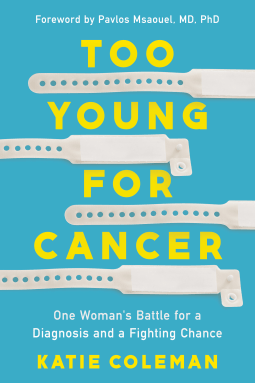
A Stage IV cancer survivor reflects on treatment and recovery in this inspiring memoir that reveals the biases of the healthcare system—and the power of community.
New Year’s Eve 2020 was supposed to be a turning point to better days for twenty-nine-year-old Katie Coleman. Instead, she found herself in the ER processing the earth-shattering news of a stage IV cancer diagnosis, one that had come after years of being assured she was “too young for cancer” and a repeated misdiagnosis of anxiety.
Too Young for Cancer tells the story of Katie’s journey from diagnosis with an ultrarare cancer through treatment, recovery, and a life-altering shift in perspective. Katie starts her journey shy, timid, and frightened of an intimidating medical world, but as she learns how to advocate for herself, she faces her own mortality with bravery and finds herself at top cancer institutions arguing her case for a radical and high-risk surgery that could change her life forever.
With support from her husband, innovative doctors, and a diverse community of cancer survivors, Katie finds her life’s purpose to advocate not only for herself but also for others who are fighting just as hard for their lives.
*****
Thanks to NetGalley and Alcove Press for the advanced copy of this title in return for an honest review.
I’m not sure I can review this book without making it personal, and I’m not sure I can review it as a book in itself. It’s so deeply personal, that to critique it’s writing style for instance seems insensitive. So I will instead comment on what I felt when reading it.
I wasn’t aware of Katie prior to reading this so had a quick little Google, and her story is impressive – if not always for the good.
In a way, whilst not quite the same, there are some comparisons with my own family cancer story. When my dad was diagnosed with oesophageal cancer in 2017, a nurse told me not to worry, he was young (56), had never drunk or ever smoked. Which seems ironic considering oesophageal cancer is more prevalent in older men who smoke or drink. But cancer doesn’t care about that. It doesn’t care about your age or fitness level or medical history. And that’s what makes it even harder to deal with at times, because you can do all the “right” things, and it’ll still come.
As sad as it is, Katie talks about how, whilst doctors want to help you, an increase in patients and a decrease in money means there is a decrease in the time they can spend with you, and quite often serious diagnoses are not given until it is too late. My health condition is not the same as cancer and I am in now way comparing it, however I started to get sick in 2017 and I saw every neurologist, rheumatologist, ophthalmologist, and gastroenterologist I could, but after an initial diagnosis in 2021, it wasn’t until 2022 I was finally diagnosed. Initially it was: “could it be stress or anxiety” (always the way), was it about “your weight” (again, every medical problem is down to my weight); “oh yes I get numb legs when I sit on them” (not the same as being temporarily paralysed, but okay), “there’s a spot on the cross-section of your spine that looks interesting but we’re not going to investigate it further”. It’s those kind of things, and it makes you feel crazy, like it’s all in your head, looking for symptoms that aren’t actually there, and so I really felt for Katie.
She has been so open and honest about everything, which can’t have been easy to revisit. And no matter how accomplished you are as a writer or wordsmith, it can feel almost impossible to put down your feelings into words. You can describe the symptoms and the diagnosis and the procedures, but to explain the fear and worry and sadness and the whole plethora of other emotions that something like this can cause is almost impossible.
It might not be everyone’s cup of tea. I think on one hand it would really help those living with cancer, to see what can be achieved, but it may also frighten those who are early on in their cancer journey. I would recommend it to loved ones and friends of people with cancer, and definitely those interested in the cancer/medical/caring fields.
You would probably assume it’s going to be quite a negative and miserable book given the topic. And yes, it’s not always a happy positive read. It is hard and honest and raw and sad. But it also manages to be quite hopeful, amongst all of that, which is a difficult thing to achieve. She’s kept all the horrible truthful parts, but shown that it is possible to live well with cancer.
 Books By Your Bedside