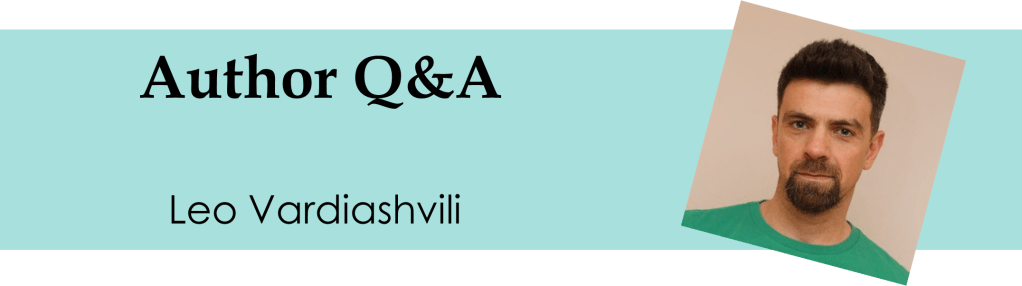
Leo Vardiashvili came to London with his family as a refugee from Georgia when he was twelve years old. He studied English Literature at Queen Mary University of London. Hard by a Great Forest is his first novel.
Meet Leo Vardiashvili
Questions on Writing
What was the hardest bit about writing Hard By a Great Forest?
I had to write Hard By a Great Forest around a demanding day job. This meant I wrote on the way to work, during lunchtimes, after work and most weekends. Who needs spare time anyway? The process of writing itself was so fulfilling, and it’s probably what I would have done with my spare time anyway. Nonetheless, it was hard and felt like doing two full-time jobs at the same time.
What have you learned about yourself when writing?
I learned that my writing time falls into one of the following tiers:
On good days – the best case scenario – I finish editing yesterday’s work and the next sentence just flows naturally from there.
On bad days, when producing new sentences feels like pulling my own teeth, I spend my time editing what I’ve already written.
On worse days, I abandon the editing too, and stick with just checking basic spelling, punctuation and grammar.
As an absolute failsafe, I can always spend my time researching the next location or character in my story. I’ve never came across a day so bad where I can’t manage a few Google Image or YouTube searches, and scribbling down some notes. Every little bit of effort adds up.
Do you make yourself write everyday/regularly, or only when inspiration strikes?
I believe that waiting for inspiration is putting the cart before the horse. Inspiration comes when you’re already working. Therefore, I’m very regimented and strict with my writing time. I will make myself sit there and work – no matter how ‘inspired’ or ‘uninspired’ I’m feeling. Writer’s block is a myth – there’s so many useful things to be doing if new words aren’t coming.
What does literary success look like to you?
Quite simple – I would love to give up my day job, be a full-time author and produce many more novels well into my old age.
How much planning/world building do you do before writing, and how much comes along as you write?
No matter how skeletal, I always have a plan. Setting out without a plan is like setting out without a map – just asking for trouble. Planning brings a multitude of benefits for plot, character arcs, and the ending. I find that as I write, the plan evolves, changed, and becomes more detailed too.
What was it that inspired you to write this particular book?
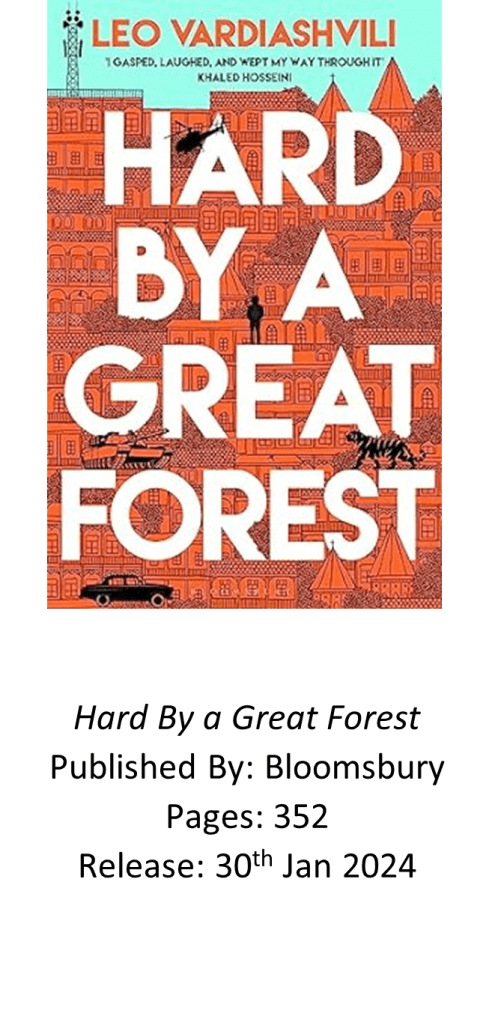
Some history is shared by my main character, Saba, and me. My family also fled Georgia’s civil war. Just like Saba, I didn’t go back home for nearly twenty years. On that first trip back, sometime during the long flight, my plane must have slipped through a portal. I say this because when I landed, I found I had time-travelled to my childhood. I set out writing Hard by a Great Forest to make sense of this surreal homecoming. Unlike me, Saba returns to Georgia entirely unwillingly. His dad goes missing in Tbilisi, as does his brother. Saba has no choice but to return and look for them both. His passport is confiscated on arrival, the zoo animals have escaped, and the breadcrumb trail of clues he’s following takes him to all the places a tourist would not go.
How did you celebrate when your book was published?
I had a cosy book launch event at Warwick Books – a lovely indie bookshop I would recommend to anyone in the Midlands.
Questions on Books and About You
Firstly, the most important question, what books are currently ‘on your bedside table’?
The Wandering Souls by Cecile Pin – an unflinching book about the refugee experience, and The Instrumentalist by Harriet Constable, an advanced copy of a book that I think will storm the UK when it comes out.
What children’s book would you suggest every adult read?
Without a shadow of a doubt, Alice in Wonderland of course!
What does your writing space look like?
I like a spacious desk, plenty of coffee, and a window to stare out of pensively.
How many books do you think you own?
Too many. I’ve kept all my books from my English Literature degree, so if we include those – well into the hundreds of books.
Who is your literary icon?
I have too many to list here, but I’ve never read a Cormac McCarthy novel without coming away astonished and more than a little humbled.
If you could own one rare/1st edition copy of a book, which would it be?
One Flew Over the Cuckoo’s Nest by Ken Kesey, without a doubt.
Is there an author who you always read?
One Flew Over the Cuckoo’s Nest is probably one of my favourite novels to re-read. It’s endlessly entertaining.
And finally, are there any plans for any new books? If so, what teasers can you give us?
The only thing I can say is that it’s in the works!
Thank you Leo😊I have a copy of One Flew Over the Cuckoo’s Nest but I haven’t got round to reading it yet, but you’ve just bumped it up my TBR pile!
Leo Vardiashvili’s Books
 Books By Your Bedside
Such an interesting interview! This is a book I will definitely be checking out 🙂
LikeLike