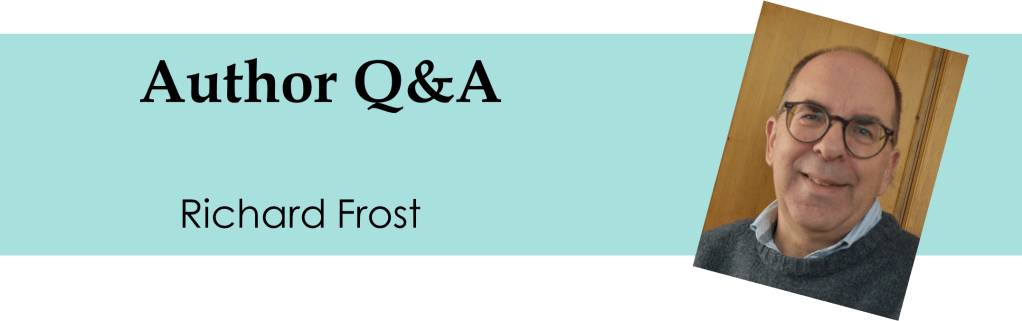
I’m married to Jane, who’s a vicar, we live in Devon with our cocker spaniel, Daisy and we have two adult children. I’m a former mental health and employment specialist and a lay licensed minister. I was appointed MBE in the Queen’s Birthday Honours 2018.
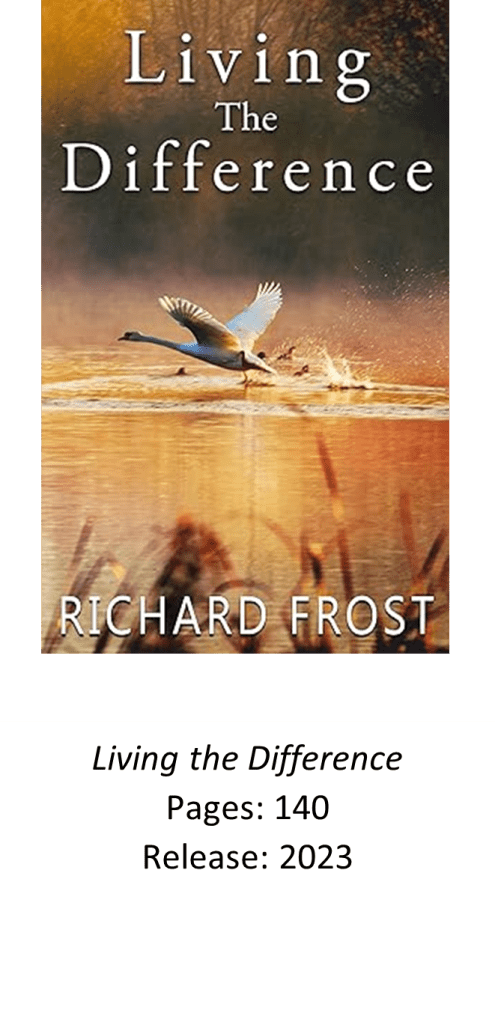
I’ve been writing articles, book reviews and other stuff since the early 1990s but didn’t get to book stage until 2019. Five books now – three faith related (2 traditional published; 1 self-published) and two fiction (both trad). The two novellas, Looking to Move On and Living the Difference form the Eastwood Story series. Fiction was a lockdown surprise – I started reading a lot more and then suddenly started writing it
Meet Richard Frost
Questions on Writing
What is the hardest part of your writing experience?
Actually, it’s not so much the writing. Over the years, I’ve developed my own style and approach – in both non-fiction and more recently, fiction. Writing fiction requires more effort in terms of generating ideas, of course. But the hardest part in both genres is the marketing. Four of my five books are published by traditional publishers but even with their backing and ability to deal with the distribution elements, like most authors, it’s down to me to spread the word – which in such a crowded room is barely a whisper.
What have you learnt about yourself when writing?
Good question. Probably a lot! But the one thing that comes to mind was when in a recent radio interview, the presenter asked me if the fiction was cathartic: a way of working through all the experiences and encounters I had had (especially in my professional career). I felt that was a good insight and is probably true. I loved my job and was privileged to be able to make a difference in the lives of many people and organisations but it took its toll also at times.
Do you make yourself write everyday/regularly, or only when inspiration strikes?
It tends to be when inspiration strikes and when time allows. I often write in my head and then put it down when I can – that can sometimes be just a note or whole paragraphs. Sometimes it’s the same day, other times longer – but that also allows for ideas to stick or not.
What does literary success look like to you?
Receiving nice comments – I’ve learnt not to focus on numbers of reviews or sales etc. It’s when someone tells me they’ve found the book enjoyable or something I’ve written which they have found helpful which is the best.
How much planning/world building do you do before writing, and how much comes along as you write?
It varies. With the non-fiction books I tend to plan out an ‘order’ of how to explore the topic and what that might look like (and then change/adapt as the book develops). With fiction, it’s been largely a case of let’s start here… or having a number of individual elements and then see how it goes. It’s true what people say about how stories take on a life of their own!
How did you feel making the jump between non-fiction writing, and novel writing? Do you prefer one over the other, or are you happy to write across genres?
In those pandemic times I started reading more fiction and then started writing it. Short stories to begin with (which later found their way in to the novellas) and then I had an idea for what became the opening paragraphs of Looking to Move On. No idea where it came from but it stayed with me for a couple of weeks. I enjoy the ‘freedom’ of writing fiction where one can write whatever one wants really. I also enjoy the non-fiction where there’s more structure and focus. Bit of both: bit like me, really. I enjoy weaving things together in the edit and making sure it all makes sense (hopefully!)
How do you celebrate when a book is published?
I’ve put on book launches for each one (with variable attendance, has to be said). Buns for tea have featured too!
Questions on Books and About You
Firstly, the most important question, what books are currently ‘on your bedside table’?
Biggles on the Home Front by Capt WE Johns – well, you did ask! I have 92 of the 99 Biggles books (and all of the Jennings books by Anthony Buckeridge). Good, easy bedtime reading. On the table beside the sofa are currently Agatha Christie: A Very Elusive Woman by Lucy Worsley and Hercule Poirot’s Silent Night by Sophie Hannah.
What children’s book would you suggest every adult read?
See above! There are so many but There’s No Such Thing As a Dragon by Jack Kent and Thud! By Nick Butterworth come immediately to mind.
What does your writing space look like?
Man cave. Desk. Laptop. Mess.
How many books do you think you own?
My wife’s an avid reader, former English teacher and now a vicar so combined with mine, well over a thousand.
Who is your literary icon?
To be honest, I don’t have one.
If you could own one rare/1st edition copy of a book, which would it be?
One of the remaining seven Biggles books – all of which are rare and very expensive!
Is there an author who you always read?
Not really, but in recent times I have read Ann Cleeves, Sophie Hannah and Agatha Christie quite a bit.
And finally, are there any plans for any new books? If so, what teasers can you give us?
Yes, Eastwood Story Book 3 is underway!
Thank you Richard😊I’ve not heard of the Biggles series before but I will definitely check them out!
Discover more about Richard and his writing at http://richardfrostauthor.com/ and at @richardnfrost.
Richard Frost’s Books



 Books By Your Bedside