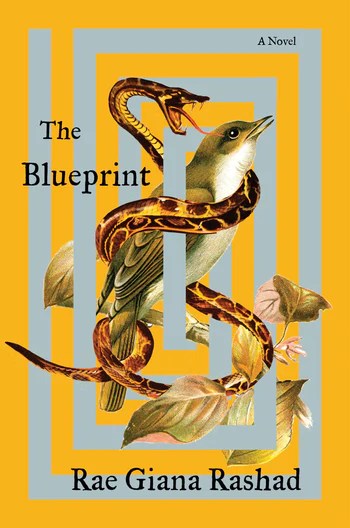
Published By: HarperCollins
Pages: 320
Released On: 13/02/2024
Solenne Bonet lives in Texas where choice no longer exists. An algorithm determines a Black woman’s occupation, spouse, and residence. Solenne finds solace in penning the biography of Henriette, an ancestor who’d been an enslaved concubine to a wealthy planter in 1800s Louisiana. But history repeats itself when Solenne, lonely and naïve, finds herself entangled with Bastien Martin, a high-ranking government official. Solenne finds the psychological bond unbearable, so she considers alternatives. With Henriette as her guide, she must decide whether and how to leave behind all she knows.
Inspired by the lives of enslaved concubines to U.S. politicians and planters, The Blueprint unfolds over dual timelines to explore bodily autonomy, hypocrisy, and power imbalances through the lens of the nation’s most unprotected: a Black girl.
*****
Thanks to Michelle from Michelle Blankenship PR for the advanced copy of this title in return for an honest review.
I believe this is Rae’s debut novel. It has some flaws that often come with a first hovel, but it’s got powerful themes, captivating characters, entertaining prose, lyrical sentences; it shows great promise for Rae’s future works.
It’s split into three timelines:
- 1801: We follow Henriette, a black female slave.
- 2030: We follow Solenne, a black female who is in a relationship with the white Government official Bastien, and is Henriette’s descendent.
- And then we have a timeline in between the two of them, where we see Solenne as a younger girl.
It wasn’t always clear to me which timeline we were in or whose POV we were reading. It would have been better if at the start of each chapter it specifically said the year and the character. It does say THEN and NOW, which I took to mean 1801 and 2030, and it’s not a huge issue, but I think it would have made it clearer to read with a bit more setting information. It also flits between time periods in the same chapter with no warning, and so that lost me on several occasions, so you do have to keep your wits about you.
If I’m honest, I wanted more of Henriette’s story. We get the introductory chapter about her, but then it’s not until 1/4 of the way through the book that we return to her. We get more from her after that but I so wanted to read more about her. I know this was more Solenne’s story than Henriette, but I love reading historical novels and I was more gripped by Henriette’s story than any other.
Solenne’s story was interesting; a black woman dating the white government official who is in charge of implementing the rules around black people. It’s controversial and tense, but interesting. She’s very powerful. People would call her bossy or rude or overemotional, just because she’s a woman, but she knows herself, and is her own woman, and I liked her.
As a white woman, I often find it difficult to completely appreciate characters of colour for whom this is a disadvantage. It’s not a conscious decision; I, of course, can appreciate how difficult life in the U.S has been and can be for people of colour. But as someone who hasn’t had to grow up with that, I can feel a bit far away frrom the story. But this had a way of grabbing me and pulling me in, and I could feel every insult, every threat, and it didn’t matter whether the colour of my skin matched that of the characters. There was just humanity, in all it’s conflicting glory.
I liked the fluid narrative, the poetical prose, but I will admit that at times, I felt it went a bit much and my attention was less on the story and more about the words that told the story. It wasn’t overwhelming and for the most part I thought it was fine, but it does need some working through at times.
It is a mixture of historical novel, dystopian, romance, and action – quite a lot of things but it never quite hits any of them fully. It’s good and I enjoyed reading it and I would recommend it to others as I think the positives outweigh the negatives, but it feels like it was stretched a bit too thin. I think it would have been stronger if she’d focussed more on the historical elements or the dystopian elements, because by trying to hit a number of genres, it misses the mark for me.
This is not always a comfortable book to read, but it’s so powerful and eye-opening and captivating. It really explores how someone learns to navigate a world that wasn’t built for them; a world that has always put you on the back foot.
 Books By Your Bedside