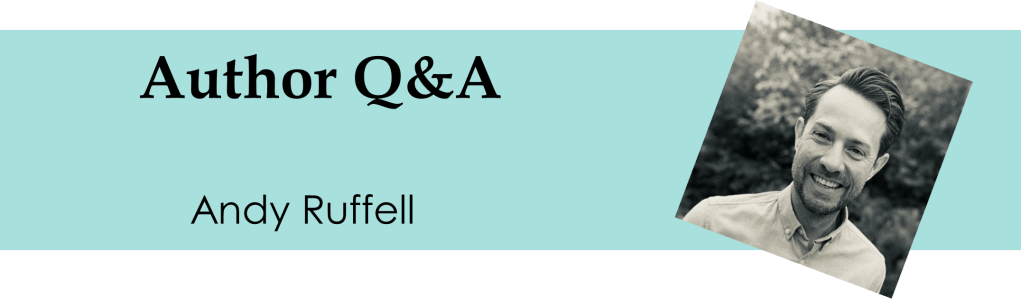
Although Andy had always wanted to be a writer, he didn’t have a serious go at it until he was 45. Being a writer was the only childhood dream that hadn’t been snuffed out by the realities of adult life. He was scared of trying to write a book and failing because that would have crushed that long-treasured dream, but looking back, he wishes he’d had a go sooner!
Even though he didn’t write much before reaching 45, he had always immersed himself in stories. After stubbornly resisting most attempts to teach him to read, he was finally spurred on when he saw how far ahead in the ‘Peter and Jane’ reading scheme is friend Alex was. But once he’d got the bit between his teeth, he could see that practising now only made reading easy, but pleasurable, and he’s been an avid reader since.
He studied English Literature at University, before messing around doing lots of jobs that had nothing to do with English (bar work, call centres, a soul-crushing year training as an accountant, analyst, energy treader) but ended up becoming a primary school teacher. This gave him lots of chances to write for the children in his class, but he still never wrote anything longer than a page.
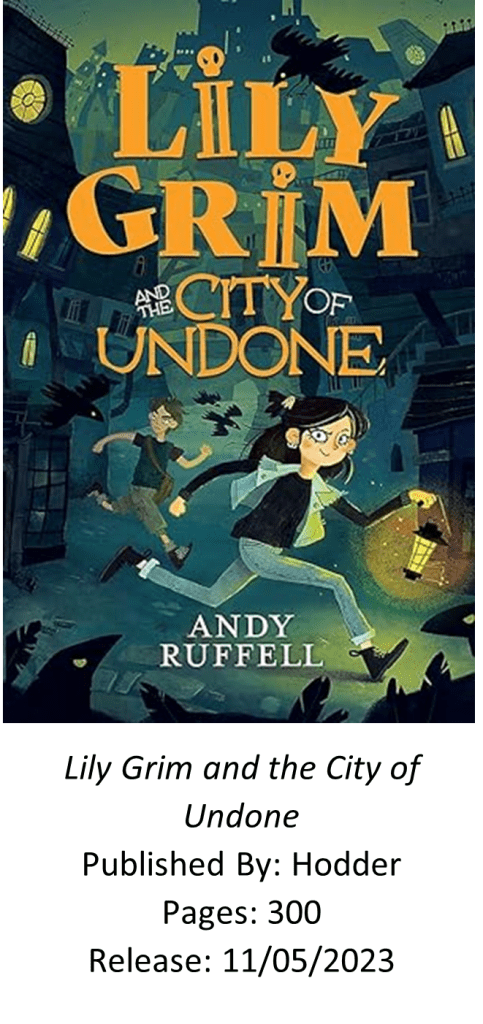
In the end, it was the stress of running a school during the pandemic that made him write. His wife saw that he needed something to take his mind off keeping everyone in the school safe, so she told him tow rite a book. He started in the October/November half-term break and wrote every day, after school, and at weekends, and in about eight weeks he had the first draft of Lily Grim and the City of Undone. He tinkered with the opening at Christmas, and at the start of February he entered it into the Hachette Children’s Novel Award, not expecting to get anywhere with it. But during the Easter holidays, he happened to check his junk mail and found out that Lily Grim had been longlisted and he needed to send the full manuscript. His advice to everyone now is to check your junk mail! In the summer of 2021, he won the award which came with a publishing contact with Hachette. Two years later and it still hasn’t properly sunk in.
Meet Andy Ruffell
Questions on Writing
What was the hardest part of writing Lily Grim and the City of Undone?
Overcoming my default settings – procrastination and self-doubt! Once I’d got started, it ended up not being as hard as I thought it would be. However, I was extraordinarily lucky that my wife was happy to let me use up my spare time and simply write for a couple of months. In ‘normal life’, that’s not really possible and I’m learning to accept that spare time doesn’t just happen or get given to you, you have to make it (and it’s hard to make!)
I was also very lucky to have a fantastic editor, Jenna Mackintosh, who helped shape the story into the best version it could be. Jenna’s request for a new ending that tied up every loose end was tough to deliver (especially when, having done so, I had to cut around 15,000 words!) but it forced me to grasp the nettle and just get it sorted out. Editors are such a vital part of the writing process!
What have you learnt about yourself when writing?
That although writing can be tough to get started, if you just sit down and have a go, something will appear on the page. You may go back and read it at a later date and not be particularly pleased with it, but at least you’ve got something to work on and you’ve made a start.
Also, the more time you spend on writing, the more you’ll discover new ideas, characters, settings and potential concepts and plots. Actively engaging with a creative process doesn’t use up your imagination, it adds to it.
Do you make yourself write everyday/regularly, or only when inspiration strikes?
Ha! My top advice for anyone is to try and write little and often but I’m terrible at sticking to that advice. I tend to write in bursts over a week or two and I can get plenty written, but then do nothing but read and daydream for several weeks. I’m very easily distracted and struggle sitting still for any longer than an hour so, if I’m spending a day writing, it invariably involves regular breaks to wander about the house while I talk to myself. I’m best at working to a deadline and, as much as I squirm under the pressure of it, I quite enjoy the challenge.
What does literary success look like to you?
Knowing that someone, somewhere is reading a book I’ve written and that the world and the characters are taking life inside that reader’s imagination feels magical. I’d love to earn a living from writing, so that it could be my sole focus rather than something that I have to fit around a full-time job but, in the meantime, knowing that my words are living inside someone else’s head feels like a big win.
How much planning/world building do you do before writing, and how much comes along as you write?
I don’t make lots of notes while I’m planning and world-building, but I do invest a huge amount of time in daydreaming. I will constantly visit the world and talk through the plot to myself, particularly if I’m engaged in a solitary task like running, walking, or gardening where I can let my mind wander. When I’m trying to tie up loose ends in a plot, I tend to think through these as I fall asleep. I don’t always get them sorted out before I drift off, but when I return to the problem the following day, a solution usually presents itself.
What was it that attracted you to write a book for children?
I have always wanted to write for children. Children’s books had such a profound effect on me as a young reader that it felt natural to want to replicate that feeling for others. Writing for children is tough – they won’t put up with any self-indulgent padding, so it really helps you to focus as a writer and distil your story into the clearest spirit it can be. Knowing that you’ve held a young reader’s imagination for 40-50,000 words is so motivating – especially if your book is one they return to or recommend to their friends.
How do you celebrate when a book is published?
When Lily Grim and the City of Undone was published, I spent the day visiting a handful of local bookshops and then popped into the primary school I had been headteacher at to say hi to the staff and children. In the evening, I went out for a meal with my wife and two daughters. I’m not someone who really enjoys being the centre of attention, so I tend to keep things pretty quiet.
Questions on Books and About You
Firstly, the most important question, what books are currently ‘on your bedside table’?
I’ve just finished Francis Spufford’s Light Perpetual (a fabulous book that perfectly encapsulates the strange magic an author weaves when creating new, believable lives for totally fictitious characters). Given that we’re approaching Halloween, I’ve just picked up The Haunting Season: Ghostly Tales for Long Winter Nights which I bought for my wife last year. When that’s finished, I’m planning on working my way through anything I can get my hands on that deals with wintry hauntings and predatory beings in preparation for an adult novel I’ve promised myself I’ll write.
What children’s book would you suggest every adult read?
I am a huge fan of Louis Sachar’s Holes which has the most perfect plotting – along with fabulous characters and setting – of any book of its length that I’ve ever read. I also love, by Louis Sachar again, There’s a Boy in the Girls’ Bathroom and I think that all school staff should read it as part of their training. It’s such a great lesson on understanding and empathy and it has the most satisfying character arcs you could ever wish for.
What does your writing space look like?
I always type rather than handwrite. That surprised me as I love scribbling notes and ideas down by hand… But, in the end, I found my mind jumped about too much and the words came too quickly, and handwriting left me feeling impatient and anxious that I’d forget things before I’d written them. So I almost always write on a laptop which could technically be anywhere because I don’t need anything else, but is almost always at our dining table. The only thing that really matters to me is that I find it hard to write if there’s a lot of background noise. There is no way I could sit and write in a café because I’d find the people around me too distracting.
How many books do you think you own?
Easily over a thousand (and that’s probably massively underestimated)… I daren’t actually count them!
Who is your literary icon?
I absolutely love Laurie Lee’s writing and have always admired the way he can produce simple prose that sounds like poetry. The opening sentence of As I Walked Out One Midsummer Morning is understated perfection and always brings a lump to my throat.
If you could own one rare/1st edition copy of a book, which would it be?
Although Laurie Lee’s As I Walked Out One Midsummer Morning is my favourite book of all time and I read it almost every year, I think that holding an original copy of The Hobbit would make my heart sing. The Hobbit was the first ‘big’ book I ever attempted reading as a child and it swept me away. It made such a huge impression on me, and I returned to it so many times throughout my childhood.
Is there an author who you always read?
As well as always reading Laurie Lee, I’ve discovered a love for the historical novels of Dorothy Dunnett. My mum had recommended them to me for years but, like many young men, it took me far too long to heed my mother’s advice!
And finally, are there any plans for any new books? If so, what teasers can you give us?
Over the next month or so, I’m hoping to get a middle grade ghost story finished off. It’s quite dark and creepy but tempered with silliness and fun and I love the main character, Buddy, whose cheeky smart-talking attitude can’t help but get him into trouble. After that, I’ll start working on a thriller for adults that’s set in winter on the North Yorkshire moors – think Stephen King’s The Shining meets Dan Simmon’s The Terror.
Thank you Andy 😊Thanks for the recommendation, I will definitely check out Francis Spufford’s Light Perpetual
Andy Ruffell’s Books
 Books By Your Bedside