Published By: Simon and Schuster
Pages: 512
Released On: 31/08/2023
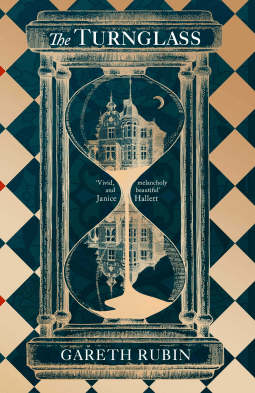
Imagine you’re holding a book in your hands. It’s not just any book though. It’s a tête-bêche novel, beloved of nineteenth-century bookmakers. It’s a book that is two books: two intertwined stories printed back-to-back. Open the book and the first novella begins. It ends at the middle of the book. Then flip the book over, head to tail, and read the second story in the opposite direction. Both covers are front covers; and it can be read in either direction, or in both directions at once, alternating chapters, to fully immerse the reader in it.
1880s England. On the bleak island of Ray, off the Essex coast, an idealistic young doctor, Simeon Lee, is called from London to treat his cousin, Parson Oliver Hawes, who is dying. Parson Hawes, who lives in the only house on the island – Turnglass House – believes he is being poisoned. And he points the finger at his sister-in-law, Florence. Florence was declared insane after killing Oliver’s brother in a jealous rage and is now kept in a glass-walled apartment in Oliver’s library. And the secret to how she came to be there is found in Oliver’s tête-bêche journal, where one side tells a very different story from the other.
1930s California. Celebrated author Oliver Tooke, the son of the state governor, is found dead in his writing hut off the coast of the family residence, Turnglass House. His friend Ken Kourian doesn’t believe that Oliver would take his own life. His investigations lead him to the mysterious kidnapping of Oliver’s brother when they were children, and the subsequent secret incarceration of his mother, Florence, in an asylum. But to discover the truth, Ken must decipher clues hidden in Oliver’s final book, a tête-bêche novel – which is about a young doctor called Simeon Lee . . .
*****
Thanks to NetGalley and Simon and Schuster for the advanced copy of this title in return for an honest review.
The reading of this book straddled both July and August. I was sent part 1 in July from NetGalley, and then part 2 by Simon & Schuster in August and so my reading of it was split, but I hope this review ties both parts up nicely.
The first section I received covered the 1880s story – although you can read them in either order, but having read both, I think it works better this way. It is very chilling, the eeriness, the terror, the silence, it all seeps from the page and you find yourself perched on the edge of your seat, about to slip into this frightening and uncomfortable but curious world.
I then read the 1930s section as part 2 – but again, you can read this one first if you want to. I knew it was linked to the first story, of course, but it’s not obvious to begin with, and I found that exciting, trying to remember what happened in the other story and would this one could be eluding to. It draws you in before offering up its goods.
It is a very clever way of writing: two different stories, but both linked, and within those stories are more stories. Which one is the true story? The real characters? It’s beyond me how someone could write something like this so successfully. I mean, how do you write two stories that are linked, but can be read as standalone stories, and in either order. I can only applaud Gareth for managing it.
If I had to pick, I think I enjoyed the 1880s story a smidgen more, but we’re splitting hairs here. I would have gladly read full books about either story, which is unusual for me, as I rarely ask for a longer book.
I was given a digital copy of this book and so was worried it wouldn’t have quite the same effect if I couldn’t physically turn the book halfway. It didn’t stop the enjoyment of the book, but I will have to get my hands on a physical copy at some point so I can experience that. I feel it deserves to have the full effect felt by holding it in your hands. And I also want to find out which cover – green or red – fits which story.
It’s a murder mystery, a psychological thriller, a gothic mystery, a horror – it is so layered and it’s got so much depth, in both parts. It’s about terror, yes, but there’s a warmer heart to it in my opinion. One about family and friendship and love, and to what extent would you go to protect them, whether someone can be truly good or truly evil, what we consider to be acceptable and what would be too much. And it really makes you think about your own moral decisions.
After finishing it, I found that if you go on http://www.thebooktrail.com, you can visit the locations in the book and I think it would be really interesting to see these places, and then reread the stories to see if they come alive any more.
It is fully immersive and all consuming. If you’re like me, you’ll find it near impossible to read either story with any distractions. You need your full attention, it deserves it, and you’ll find the stories easier to link. But you’re absorbed in it from page 1 – whichever page 1 you decide to start from.
I can’t see there being another book in this vein or a series or anything, as everything is rounded up nicely, but it has whetted my appetite as to what Gareth can and will produce next.
 Books By Your Bedside
One thought on “The Turnglass – Gareth Rubin”